Picking a microcontroller for your first product feels like the biggest decision on the whole project. It is not. But it quietly sets your part cost, your compliance bill and how much firmware you end up writing, so it deserves an afternoon rather than ten minutes.
This post compares the three families most non-EE founders end up choosing between: ESP32, RP2350 and STM32. Real prices, checked this month, plus the parts nobody puts in the marketing copy.
The short answer
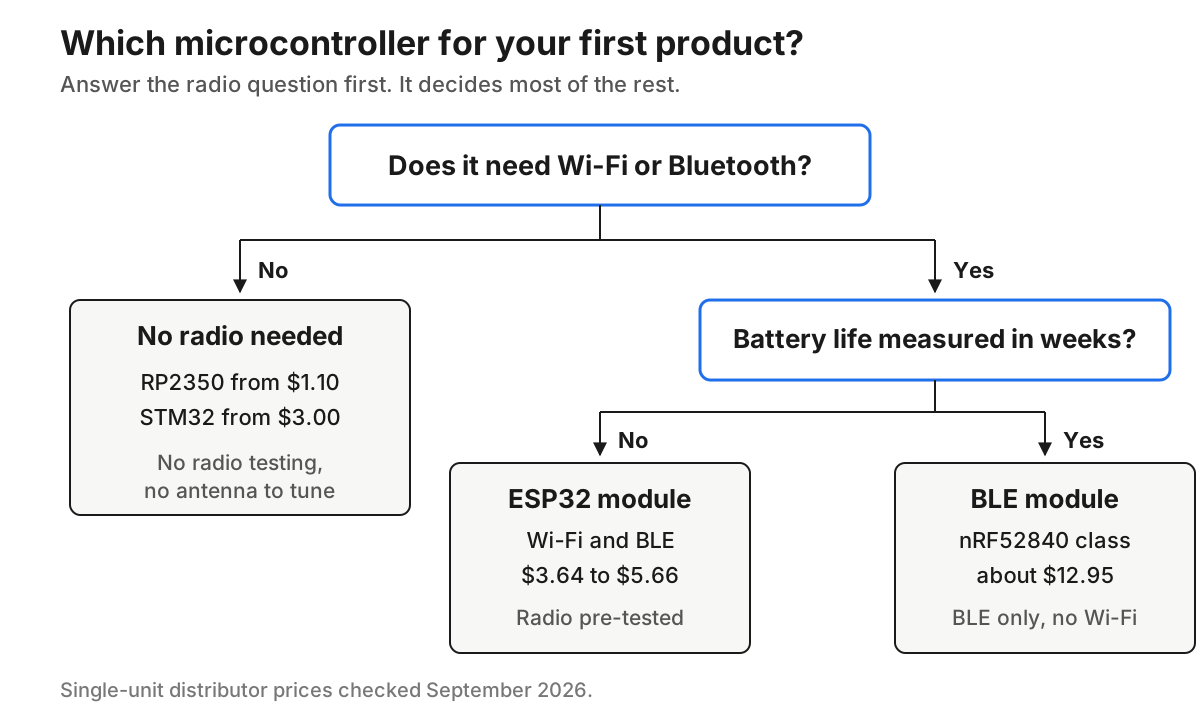
If your product talks to a phone or the internet, start with an ESP32 module. If it needs no radio and you want the cheapest compute you can buy, look at the RP2350. If you need long battery life, careful analog work, or a part you can still order in ten years, look at STM32. If it runs on a coin cell and only speaks Bluetooth, look at an nRF52840 module instead.
That covers most first products. If you are still on a dev board and the real question is how to get off it, I wrote about that separately: from Arduino to a custom PCB.
Start with the radio, not the clock speed
Most founders open three datasheets and compare megahertz. Skip that. On a first product the clock speed almost never matters. Wireless is the decision that cascades into everything else: package, antenna, layout rules, power budget and most of your compliance cost.
So ask two questions, in this order. Does the product need Wi-Fi or Bluetooth? And does it need to run for weeks on a battery? Those two answers narrow you to one family, and then you can argue about peripherals.
ESP32: the default when you need Wi-Fi
The ESP32-S3 is a dual-core Xtensa LX7 running up to 240 MHz with 512 KB of internal SRAM, 2.4 GHz Wi-Fi and Bluetooth 5 LE, per Espressif. In practice you do not buy the chip. You buy a module with the chip, the crystal, the antenna and the shielding already on it.
At Mouser today, the ESP32-S3-WROOM-1-N8 is $5.66 at quantity one, $4.27 at 100 and $3.82 on a full 650-piece reel, with 1,093 in stock. If you do not need the horsepower, the single-core ESP32-C3-WROOM-02-N4 is $3.64 at one, $2.59 at 100 and $2.22 on a reel, with 8,956 in stock.
Why it is the default: the community is enormous, it works with Arduino and ESP-IDF, and every problem you will hit has already been posted about by someone. For a solo founder that is worth more than any spec line.
Where it hurts: Wi-Fi is power hungry. If your plan is a coin cell that lasts a year, the ESP32 is the wrong starting point and no amount of clever sleep code will fix it. Pick it for products that are plugged in, or that carry a rechargeable pack and charge often.
RP2350: the cheapest way to get real compute
Raspberry Pi's RP2350 gives you two Arm Cortex-M33 cores or two Hazard3 RISC-V cores at 150 MHz, with 520 KB of on-chip SRAM, in a 7x7 or 10x10 QFN. Prices come straight from Raspberry Pi: the RP2350A is $1.10 single, $0.90 on a 7-inch reel and $0.80 on a 13-inch reel. The larger RP2350B with 48 GPIO is $1.20, $1.00 and $0.90.
A dollar for two cores is hard to argue with, and the programmable IO block genuinely solves problems that would otherwise cost you a second chip. For prototyping, the Pico 2 board is $5, and the Pico 2 W with Wi-Fi and Bluetooth is $7.
Two honest catches. First, there is no radio on the chip, so a connected product means adding a separate wireless module and doing that integration yourself. Second, the RP2350A and RP2350B have no internal flash: you add an external QSPI flash chip, which is another part, another footprint and another thing to source. Raspberry Pi has announced RP2354 variants with 2 MB of stacked flash that remove that step, so check current availability before you design around either option.
STM32: when you need low power or a long life
STM32 is less a chip than a catalog. As one concrete example, the STM32G070CBT6 is a Cortex-M0+ at 64 MHz with 128 KB of flash, 36 KB of RAM and 43 IO pins in an LQFP-48, at $3.00 for one and $1.45 at 500, with 3,488 in stock today.
Two reasons founders end up here. Low power: the low-power STM32 lines are built for battery products in a way the ESP32 is not. And supply: ST publishes an explicit product longevity program with commitments of at least 7 years and up to 20 on selected lines. If you are selling into industrial or medical, someone will eventually ask you that question.
The cost is the learning curve. The tooling is heavier, the documentation assumes an engineer is reading it, and most STM32 parts have no radio. If you need Bluetooth from ST there are wireless parts in the family, but at that point compare them honestly against a finished BLE module.
The Bluetooth-only case
If the product is battery powered and only needs to talk to a phone, a dedicated BLE part beats a Wi-Fi chip running Bluetooth. The common route is an nRF52840 module such as the Raytac MDBT50Q-1MV2, $12.95 at Adafruit, which ships with FCC, CE and TELEC certifications already done.
It is the most expensive part in this post by a wide margin, which matters at volume and barely matters at fifty units.
What these actually cost
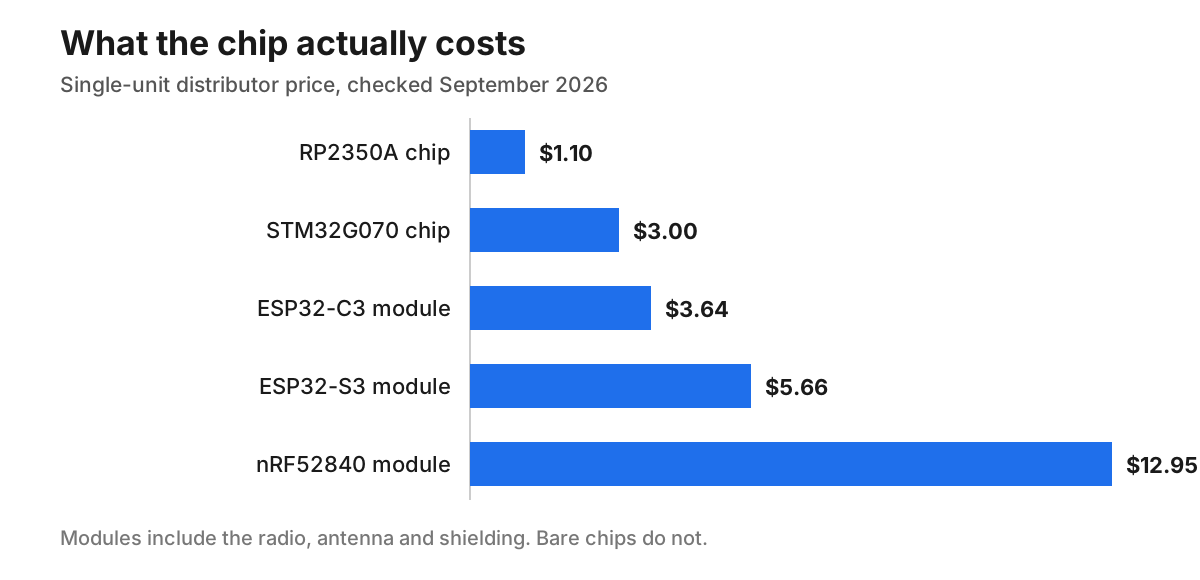
Here is the part founders get wrong about this chart: on a first run of 25 or 50 prototypes, the difference between a $1.10 chip and a $5.66 module is noise. Fabrication, assembly setup and shipping dominate. I broke those numbers down in what a hardware prototype actually costs.
Chip price starts to matter somewhere around a few thousand units. Before that, optimize for how fast you can get a working product, not for four dollars of bill of materials.
Module or bare chip
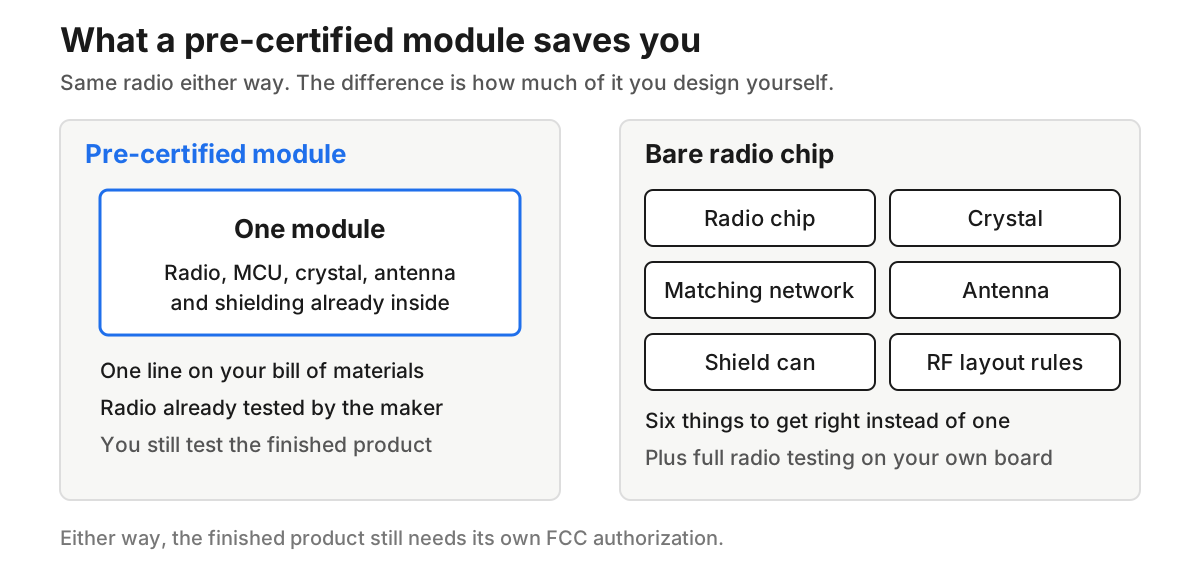
For a first product, use the module. A bare radio chip means you are responsible for the crystal, the matching network, the antenna, the shielding and the RF layout rules, and getting any one of those wrong produces a prototype that works on your desk and fails at ten meters.
One thing to be clear about, because it trips people up constantly: a pre-certified module does not exempt your finished product from FCC work. As Compliance Testing explains, the module having certification means the radio itself is already authorized, but your device still needs its own equipment authorization, usually through a Supplier Declaration of Conformity, because putting the module in your enclosure changes its emissions. The module makes that process cheaper and shorter. It does not delete it. More on that in do I need FCC certification for my device.
Three mistakes I see over and over
Choosing on specs instead of stock. The best microcontroller for your first product is one you can buy 200 of next month. Check distributor stock and lead times before you commit to a footprint, not after your board comes back.
Ignoring sleep current until the end. Battery runtime is decided by what the product draws when it is doing nothing, and that number is set by the chip you picked in week one. Work out your runtime math before you design the board, not after.
Picking a part nobody else uses. You will get stuck. When you do, a part with ten thousand forum posts behind it is worth more than any spec advantage. This is the single strongest argument for the ESP32 on a first product.
How to actually decide this week
Write down three things: does it need a radio, how long it must run on a battery, and how many units you expect to build in year one. Those three answers usually pick the family for you. Then buy the matching dev board, $5 to $15, and confirm your idea works before anyone designs a custom product.
Once you know the part, the rest of the work is schematic, layout, sourcing and an enclosure. That is the part Tovan handles: describe the product, it picks in-stock parts, draws the schematic, routes the board, fits a 3D printable enclosure around it and shows you the whole thing in 3D before you order. Update, October 2026: it now writes and tests the firmware too, in beta (here's how). The microcontroller choice still matters: it decides which chips Tovan can send code to today, and you will live inside that ecosystem for the next year.
FAQ
Is the ESP32 good enough for a real product or just for hobby projects?
It is in plenty of shipping commercial products. The reason to move off it is usually power budget or a certification and longevity requirement, not capability.
Can I put a Raspberry Pi Pico inside my product instead of designing a board?
For 5 or 20 units, yes, and people do it. It stops making sense once you care about size, cost per unit or mechanical fit, because you are paying for a USB connector and headers you do not use.
Do I need to know C to use any of these?
Not to start. MicroPython runs on both the RP2350 and the ESP32, and the Arduino environment covers ESP32 and STM32. Production firmware usually ends up in C or C++, but you can validate an idea without it.
How much does the microcontroller add to my unit cost?
At the prices above, somewhere between roughly one and thirteen dollars per unit for the part itself. On small runs it is a rounding error next to fabrication and assembly. At volume it becomes one of the larger line items.
Does using a pre-certified module mean I can skip FCC testing?
No. It means the radio inside is already authorized, which shortens and cheapens your path, but the finished product still needs its own authorization, usually a Supplier Declaration of Conformity.
What happens if my chip goes out of stock mid-run?
This is the risk nobody plans for. Two defenses: pick a part with a published longevity commitment, and try to choose a footprint with a pin-compatible sibling you could drop in. Neither is free, and on a first run of 50 it is usually not worth the effort.
Should I just use whatever my contract engineer prefers?
Usually yes, if they are going to write the firmware. The cost of them learning an unfamiliar ecosystem on your budget is larger than any part price difference.
Pick the family that matches your radio and your battery, buy the dev board, and get something working. You can optimize the part choice when you have a hundred people waiting on units.
0 comments