You have a prototype that works. Someone asks if you can sell them one, and a question you've been avoiding shows up: do I need FCC certification for my device before I can sell it?
For almost every electronic product sold in the US, the answer is yes, some form of FCC authorization is required. The good news is that for most first products the process is cheaper and simpler than founders fear, as long as you make a couple of smart design choices early. This guide explains FCC certification in plain English: which path your device falls into, what it costs, how long it takes, and how to avoid paying for it twice.
Quick note: I'm an electrical engineer, not a lawyer, and this isn't legal advice. Rules change, so confirm your specific case with an accredited test lab before you ship.
Quick answer:
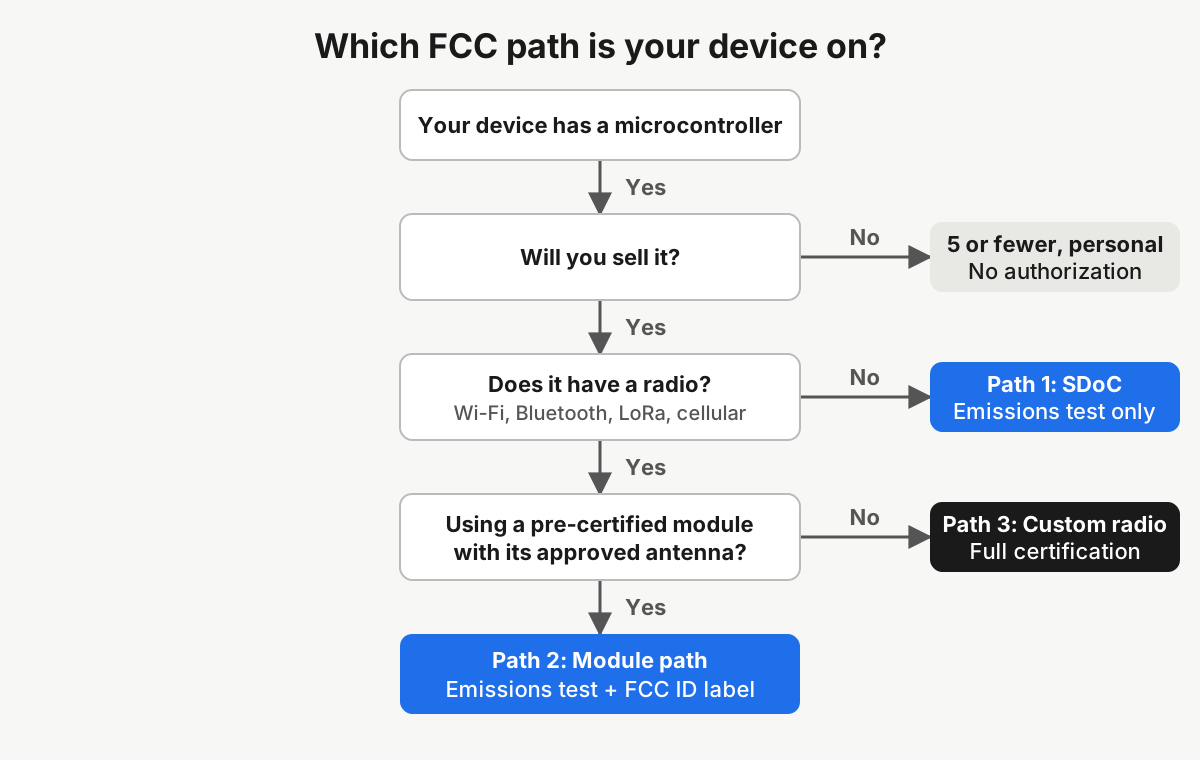
If your device has a processor or any clock above 9 kHz (so, basically anything with a microcontroller), it's a "digital device" under FCC Part 15 and needs authorization before you sell it.
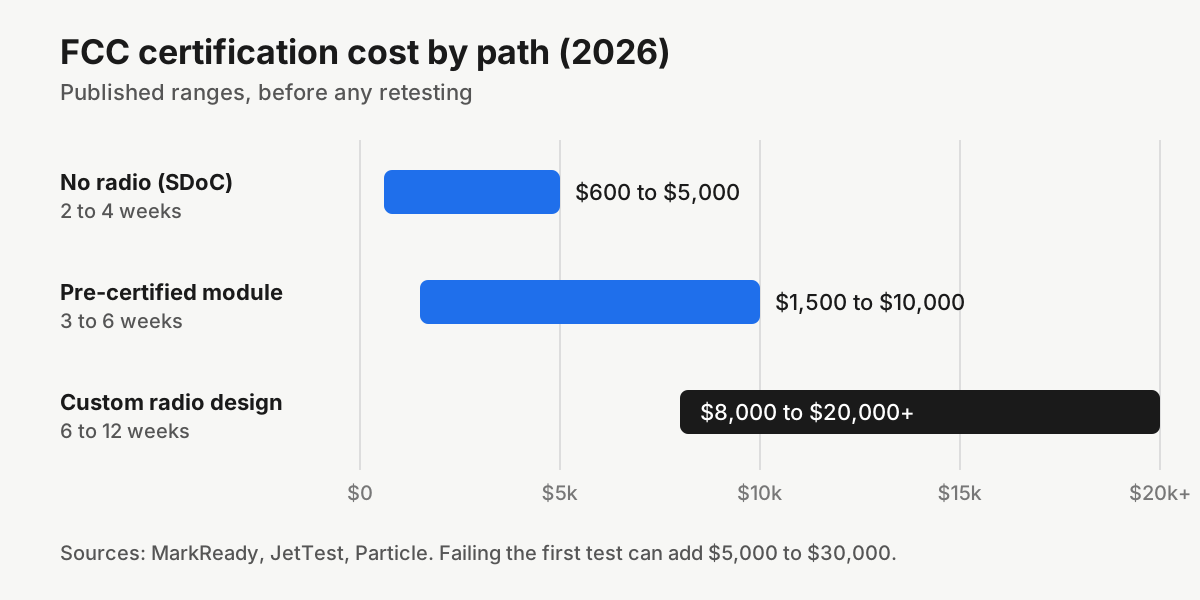
No radio (no Wi-Fi, Bluetooth, cellular, LoRa): you usually self-declare through a process called SDoC after passing emissions testing. Published ranges run roughly $600 to $5,000 and 2 to 4 weeks.
Radio, using a pre-certified module: the module's certification covers the radio, and your product still needs the same emissions testing. Budget roughly $1,500 to $10,000 depending on how much the lab has to check.
Radio designed from scratch on your own board: full certification through a certification body. Expect roughly $8,000 to $20,000+ and 6 to 12 weeks.
Building five or fewer for personal use, never sold: no authorization required.
What FCC certification actually is
The FCC regulates anything that can put out radio frequency energy, and that includes a lot more than radios. The rules for most consumer electronics live in 47 CFR Part 15, and they sort devices into categories based on how they emit RF.
Here's the plain-English version of the Part 15 definitions:
Unintentional radiator: a device that generates RF internally but isn't meant to broadcast it. Any microcontroller running a clock counts. The FCC calls anything using timing signals above 9,000 cycles per second a "digital device," which is nearly every product with a chip in it.
Intentional radiator: a device that is supposed to transmit. Wi-Fi, Bluetooth, Zigbee, LoRa, cellular, RFID readers.
Class A vs Class B: Class A devices are marketed for commercial or industrial use. Class B devices are marketed for the home or the general public, and face stricter emissions limits. If a consumer can buy it, plan on Class B.
Which category you're in drives your cost more than anything else.
Path 1: No radio, use the SDoC process
If your product has no transmitter, you're usually on the Supplier's Declaration of Conformity (SDoC) path. You pay a lab to measure your product's emissions against Part 15 Subpart B limits. If it passes, you keep the test report and supporting documents on file, include a compliance statement with the product, and you're done. There's no government filing and no FCC ID.
A few details that trip people up:
The responsible party must be in the US. That's the manufacturer or importer who signs off on compliance.
You must be able to produce the records if the FCC asks for them.
The testing is on the final product, in its enclosure, with its real power supply and cables. A bare board on your desk isn't what gets measured.
Cost and timeline: MarkReady puts the SDoC path at $1,500 to $5,000 and 2 to 4 weeks. JetTest, an overseas lab, quotes $600 to $5,000 total. Particle says this testing "can be as low as US$ 1000." Quotes vary a lot, so get two or three.
Path 2: Radio with a pre-certified module
This is where most connected products should live, and it's the single best decision you can make to keep certification cheap.
A pre-certified module is a small, shielded board that contains the radio chip, crystal, RF circuitry and often the antenna, and it already has its own FCC ID. Espressif's ESP32 modules are a common example. You solder the module onto your board instead of designing the radio circuit yourself.
Under the FCC's modular transmitter rules, the module's certification covers the radio as long as you follow the module maker's integration instructions. In practice that means:
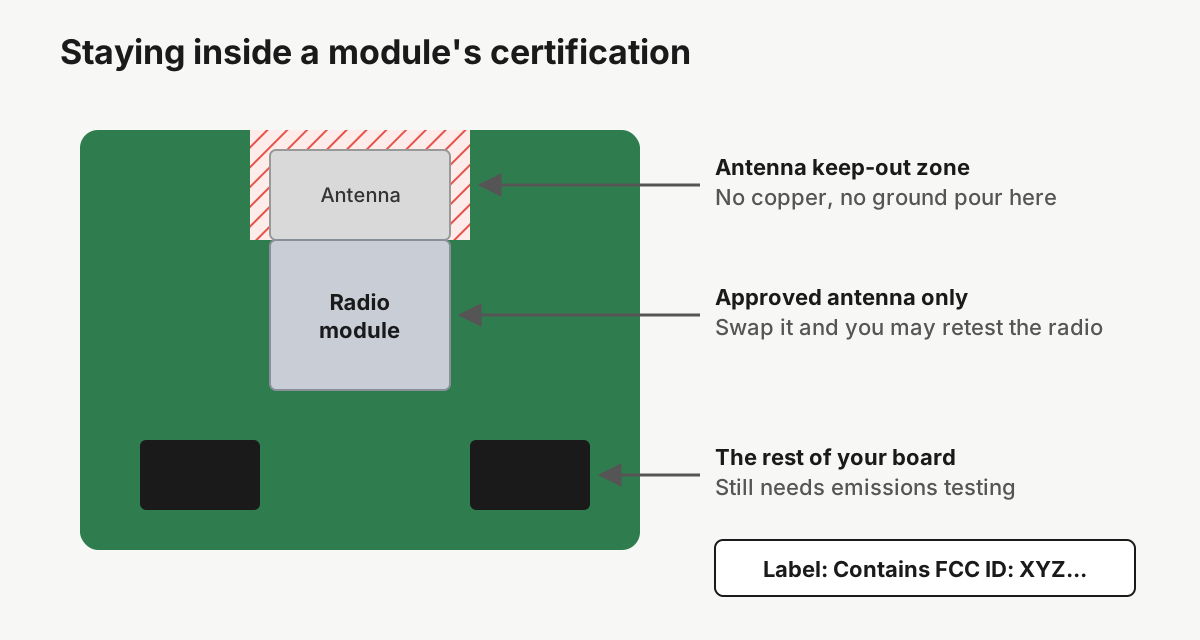
Use an approved antenna. Stick with the module's built-in antenna or one listed in its certification. Particle's docs note that using the same or a sufficiently similar antenna often lets you avoid intentional radiator testing entirely. Swap in a different antenna and you may be back to testing the radio.
Follow the layout rules. Module datasheets specify a keep-out zone around the antenna: no copper, no ground pour, sometimes no enclosure plastic right against it. Ignoring this hurts range and can put you outside the certified configuration.
Label it. If the module's FCC ID isn't visible once it's inside your product, the outside needs a label like "Contains FCC ID: XYZMODEL1."
Still do the unintentional radiator testing. The module covers the radio, not the rest of your product. Particle puts it bluntly: "Almost all products will require unintentional radiator certification," including those built on pre-certified modules.
Cost and timeline: MarkReady estimates $3,000 to $10,000 and 3 to 6 weeks for a module-based product. That figure includes a certification body filing, which you only need in some cases. If you follow the module's instructions exactly, your bill can end up closer to the SDoC numbers above. You can look up any module's grant in the FCC ID search before you commit to it.
Path 3: A custom radio design
If you put a bare radio chip on your own board and design the RF circuit and antenna yourself, your product is a new intentional radiator. That means full certification: an accredited lab tests the transmitter, then a Telecommunication Certification Body (TCB) reviews the results and issues your own FCC ID.
MarkReady puts a custom single-band Bluetooth or Wi-Fi design at $8,000 to $20,000 and 6 to 12 weeks. Products carried close to the body may also need RF exposure (SAR) testing, which JetTest lists at $2,500 to $6,000 on its own.
My opinion: unless you're shipping tens of thousands of units a year, where a few dollars per unit saved on the module adds up to more than the certification bill, don't do this for a first product. The module costs a bit more per unit and saves you a lot of money, time and risk up front.
The hidden cost: failing the first time
The quotes above assume you pass. Many first products don't. MarkReady estimates that around half of consumer electronics fail EMC testing on the first attempt, and that a failure adds $5,000 to $30,000 and 4 to 12 weeks once you count redesign, new boards and retesting. Treat that as one company's estimate, but plan for it: retesting is the part of the budget people forget.
Most failures come from a handful of design choices you can get right from the start:
Use a solid ground plane. A 4-layer board with a full ground layer is far quieter than a 2-layer board with ground snaked around.
Watch your cables. USB and other cables act like antennas. Filtering where cables enter the product, plus decent connectors, fixes a lot of failures.
Be careful with switching regulators. Buck and boost converters are classic noise sources. Follow the datasheet's layout example closely.
Do a pre-scan. Many labs will run a quick informal emissions check before the formal test. Finding a problem there is much cheaper than failing the real thing.
What you can do before you're certified
You don't have to stay silent until you have a report. Under 47 CFR 2.803, you can:
Show and advertise the product at trade shows, on your website and in demos, as long as you display a notice that it hasn't been authorized by the FCC and can't be sold until it is.
Take conditional pre-orders, as long as buyers are clearly told that delivery depends on FCC authorization and nothing ships to them until you have it.
Build a handful for yourself. Under Section 15.23, five or fewer home-built units for personal use, never marketed, don't need authorization.
What you can't do is ship paid units to customers before authorization.
Are any devices exempt?
A few, and the list in Section 15.103 is narrower than people hope. Exemptions include digital devices used only in vehicles, industrial or medical test equipment, some appliances, devices using no more than 6 nanowatts, and battery-only devices whose highest frequency is below 1.705 MHz. That last one sounds useful until you realize most modern microcontrollers run at many megahertz. Even exempt devices must not cause harmful interference.
If your product isn't clearly on that list, assume you need authorization.
How to plan for FCC certification from day one
Here's the order I'd do it in as a founder:
Decide your radio strategy first. If the product needs wireless, pick a pre-certified module with a built-in antenna before anything else gets designed.
Design for emissions, using the checklist above. On a move from a dev board to a custom PCB, this is the time to get the ground plane and module layout right.
Get lab quotes early, ideally while you're still on your first or second prototype. Ask what configurations they'll need and whether they offer a pre-scan.
Test the product you'll actually ship, in its final enclosure with its final power supply. Changing any of those afterward can mean retesting.
If you want to see how certification fits into the rest of the budget, I broke that down in how much it costs to make a hardware prototype.
One honest note on tools: Tovan, the AI hardware design tool I build, can put together a prototype around a pre-certified module on a 4-layer board, which covers two of the choices above. It doesn't do compliance testing, and it's not the right tool if your product's hardest problem is RF design or passing certification. For that, hire an engineer who has taken products through a lab before.
FAQ
Do I need FCC certification to sell a small batch of devices?
Yes. There's no minimum quantity. The home-built exemption only covers five or fewer units for personal use that are never marketed. Once you sell even one unit, it needs to be authorized.
If I use an FCC-certified ESP32 module, is my product certified?
Not completely. The module's certification covers its radio if you follow the integration rules, including the approved antenna. Your full product still needs unintentional radiator testing, and you need a label showing the module's FCC ID.
How much does FCC certification cost?
Published ranges for 2026 run roughly $600 to $5,000 for a product with no radio, $1,500 to $10,000 for a product using a pre-certified module, and $8,000 to $20,000+ for a custom radio design. Failing and retesting can add thousands more.
Can I take pre-orders before FCC certification?
Yes, under conditions. You can advertise with the required disclaimer and take conditional sales, but you can't deliver products to customers until authorization is complete.
Does a battery-powered device need FCC certification?
Usually yes. Battery power only exempts a device if its highest frequency is below 1.705 MHz, and most microcontrollers run much faster than that.
Does FCC certification cover Canada or Europe?
No. Canada (ISED) and the EU (CE marking) have their own requirements. Many labs can test for several markets at once, which is usually cheaper than doing them separately.
FCC certification feels like a wall until you look at it closely. Pick a pre-certified module, design for low emissions from the first board, and talk to a lab early, and it becomes just another line in the budget.
0 comments