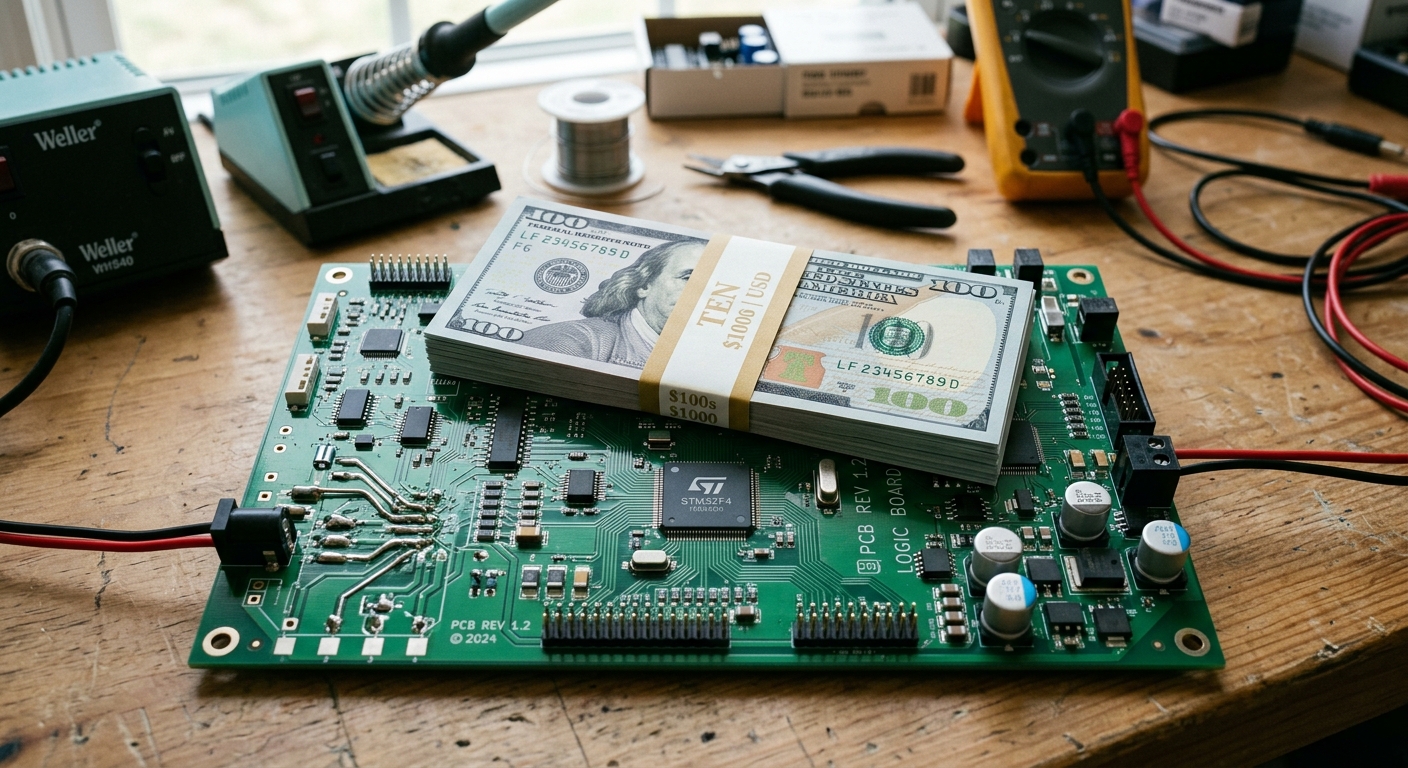
You've got an idea for a physical device. Before you quit your job, pitch investors, or spend a dollar, you want to know one thing: how much is this going to cost?
The honest answer is anywhere from $50 to $50,000+ for a simple device (and a lot more for complex ones), which is useless on its own. So this guide breaks a hardware prototype into every real expense, shows what each one costs at each stage, and walks through example budgets so you can figure out where your idea lands.
Full disclosure: I'm an electrical engineer and I build Tovan, an AI tool for designing custom circuit boards. I'll point out where it fits, but the numbers here apply no matter how you build.
Quick answer (rough ranges for a simple electronic device):
Proof of concept on a dev board: $50 to $300
First custom board prototype: $200 to $2,000 if you design it yourself or with AI tools, $1,000 to $5,000+ if you hire it out
Polished, looks-real prototype with enclosure: $2,000 to $15,000+
Certified and ready for a first small production run: $10,000 to $50,000+
The four stages of a hardware prototype
Hardware teams talk in acronyms like EVT, DVT, and PVT. Here's what they actually mean, in plain English. Costs climb sharply at each step, so knowing which stage you need right now is the single biggest way to control your budget.
Proof of concept. Does the idea work at all? Usually built from off-the-shelf parts like an Arduino or ESP32 and a few sensor modules. Cheap and ugly.
Works-like prototype (engineers call this EVT, or engineering validation testing). A custom circuit board that does the real job. Usually a handful of units.
Looks-like and works-like prototype (DVT, or design validation testing). The real board inside a real enclosure, close to what a customer would hold. This is often when certification testing happens. Typically 20 to 200 units.
Pre-production (PVT, or production validation testing). Built with the actual manufacturing process to prove you can make it at scale. Typically 50 to 500 units.
Most people reading this need stage 1 or 2. Don't budget for stage 4 until stages 1 through 3 are behind you.
Cost breakdown: every expense in a hardware prototype
1. Electronics design
This is designing the schematic and circuit board layout.
Do it yourself in KiCad or EasyEDA: $0 for software, but 40 to 100+ hours if you're learning
Freelancer: $500 to $1,500 for a simple two-layer board, per Upwork's hiring guide
US or UK design firm: $1,500 to $4,000+ for a simple layout alone
AI design tools: Tovan is free to try with Pro at $20 per month, and handles part sourcing, a custom-fit enclosure, and ordering too
For a full comparison of these options, see How to Make a Custom Circuit Board Without Being an Engineer.
2. Circuit boards and assembly
This is getting the physical boards made and the parts soldered on.
Bare boards: Often $2 to $5 for 5 simple boards from a low-cost fab
Assembled prototypes: Roughly $30 to $100 for a handful of simple assembled boards. More complex boards can run $50 to $200 per board at prototype quantities.
Small batches: At around 100 units, assembly for a simple board can drop to a few dollars per board, plus parts
Shipping and import duties: For US buyers, duties on boards from China can add 35% or more as of 2026. Don't leave this out of your budget.
Plan for at least two or three board revisions. Almost nobody gets it perfect on the first try. I didn't.
3. Parts (your bill of materials)
The components on your board: microcontroller, sensors, connectors, battery, and so on.
Proof of concept: $20 to $100 in dev boards and modules
Custom board parts: Usually a few dollars to $30 per board for a simple device. Passive parts cost fractions of a cent. Chips and wireless modules are where the money goes.
Tip: Order extras. Parts go out of stock, and waiting on one missing part can stall everything.
4. Firmware
The code that runs on your board.
Write it yourself with AI help: $0 to $20 per month. AI models like ChatGPT and Claude are very good at Arduino and ESP32 code now.
Freelance firmware prototype: $500 to $1,000 for basic ESP32 prototyping, per Upwork
Production-ready firmware: $4,000 to $7,500+ for hardened code, and more for full systems with over-the-air updates, apps, and cloud backends
Firmware is the most underestimated cost in hardware. A prototype that mostly works is cheap. A device that works reliably for thousands of customers is not.
5. Enclosure
The case your board lives in.
Home 3D printer: $150 to $300 for a good entry-level printer, then a dollar or two of material per small part. I started with an Anycubic Photon Mono M5s.
Online 3D printing service: Around $8 to $25 for a 100 gram part printed in plastic, more for resin or nylon finishes
Design: Free if you learn CAD, or paid if you hire a designer. Tovan can generate a custom-fit enclosure for your board and preview both in 3D.
Injection molding (for production): Aluminum prototype molds run about $1,500 to $8,000, and steel production molds start around $8,000 to $25,000 and go way up from there
Don't pay for a mold until your design is locked. Changing a mold is expensive. Changing a 3D print file is free.
6. Tools and equipment
If you're doing any of this yourself, you'll want some basics:
Multimeter: roughly $30 to $100
Soldering iron or station: roughly $50 to $150
Bench power supply (current-limited, great for safely powering up new boards): roughly $50 to $150
A few hundred dollars covers most early-stage needs.
7. Certification
If you plan to sell an electronic device, it usually needs certification. In the US that means the FCC. These are rough ranges from MarkReady's 2026 FCC cost guide:
No wireless (Supplier's Declaration of Conformity): $1,500 to $5,000, about 2 to 4 weeks
Using a pre-certified wireless module like an ESP32-WROOM: $3,000 to $10,000, about 3 to 6 weeks
Custom wireless design: $8,000 to $20,000+, about 6 to 12 weeks
Adding Canada (ISED): roughly $1,000 to $3,000 extra when done alongside FCC
Selling in Europe (CE), or making something that plugs into the wall or uses big batteries (UL and safety testing), adds more. You don't need certification for a personal prototype or early testing, but budget for it before you sell.
Biggest money saver here: use a pre-certified wireless module instead of designing your own radio circuit. It can cut certification costs dramatically.
8. The costs people forget
Revisions. Budget for two to three rounds of boards and enclosures.
Shipping and duties. Every round trip from a manufacturer adds cost and time.
Your time. Hours spent learning, debugging, and waiting are real costs, even if they don't show up on a credit card statement.
Contingency. Hardware almost always costs more than planned. Cad Crowd recommends budgeting double your estimate. At minimum, add 30 to 50%.
Example budgets
Let's price out one simple device three ways: a battery-powered WiFi temperature sensor that sends readings to your phone.
Budget 1: Scrappy (DIY with AI help)
You build the proof of concept, design the board yourself or with an AI tool, write firmware with AI, and 3D print the enclosure.
Proof of concept parts: $50
Board design: $0 to $60 (free software, or a few months of an AI design tool)
Boards and assembly, 3 rounds: $150 to $300
Parts and extras: $50 to $100
Firmware: $0 to $60
Enclosure prints: $30 to $100
Basic tools: $150 to $300
Total: roughly $430 to $970, plus a lot of your time
Budget 2: Hired help
You build the proof of concept, then hire freelancers for board design and firmware.
Proof of concept parts: $50
Freelance board design: $500 to $1,500
Boards and assembly, 2 rounds: $100 to $250
Parts: $50 to $100
Freelance firmware: $500 to $1,000
Freelance enclosure design and prints: $300 to $1,000
Total: roughly $1,500 to $3,900, and a lot less of your time
Budget 3: Getting ready to sell
You've proven the design and want 100 units, certified, in molded enclosures.
Design and prototypes (Budget 1 or 2): $500 to $4,000
Production-ready firmware: $4,000 to $7,500
FCC certification with a pre-certified module: $3,000 to $10,000
Aluminum injection mold: $1,500 to $8,000
100 assembled boards plus parts: $1,000 to $3,000
100 molded enclosures: $500 to $1,500
Contingency (30 to 50%): $3,000 to $17,000
Total: roughly $13,500 to $51,000
All figures are ballpark estimates for a simple device based on published 2026 pricing. Your numbers will vary with complexity, volume, and where you build. Prices change, so confirm before you buy.
How to keep your hardware prototype costs down
Prove the idea on a dev board first. It's the cheapest stage by far. Don't pay for custom boards to learn something a $30 Arduino could have told you. Here's how to go from dev board to custom PCB when you're ready.
Use pre-certified wireless modules. They simplify your design and can save thousands on certification.
Design around in-stock, common parts. Rare parts cost more, go out of stock, and cause redesigns.
Order small batches. Five boards per revision, not fifty.
3D print enclosures until your design is locked. Save molds for when you're sure.
Let AI do the heavy lifting where it's good. Firmware drafting and board design tools can save hundreds to thousands in freelance fees.
Test carefully when boards arrive. A good bring-up process catches problems before they cost you another round.
Where Tovan fits
If you're between a proof of concept and a works-like prototype, Tovan is built to cut the most expensive and time consuming part of that stage. You describe your board in plain English, and it picks and sources the parts, designs and routes the board, generates a custom-fit enclosure, and shows you both in 3D before you order everything through Tovan. When your boards arrive, you get a bring-up guide to check that everything works.
It's free to try, with Pro at $20 per month. It doesn't handle certification, and for complex high-speed or RF designs you'll still want an engineering firm. Update, October 2026: it now writes and tests firmware too, in beta, which can take the firmware line above close to zero for a prototype. Here's how. But for getting a simple to moderately complex custom board in hand without a freelance bill, it's worth a look.
FAQ
How much does it cost to make a hardware prototype?
A simple proof of concept costs $50 to $300. A first custom circuit board prototype costs roughly $200 to $2,000 if you design it yourself or with AI tools, or $1,000 to $5,000+ if you hire freelancers. Getting a simple device certified and ready for a small first production run typically costs $10,000 to $50,000+, and more for complex devices.
How much does FCC certification cost?
As of 2026, roughly $1,500 to $5,000 for devices without wireless, $3,000 to $10,000 for devices using a pre-certified wireless module, and $8,000 to $20,000+ for custom wireless designs.
How much does an injection mold cost?
Aluminum prototype molds for small parts typically cost $1,500 to $8,000. Steel production molds start around $8,000 to $25,000 and can exceed $100,000 for complex, high-volume tooling.
Is 3D printing cheaper than injection molding?
For small quantities, yes. 3D printed enclosures cost a few dollars to about $25 per part with no upfront tooling. Injection molding becomes cheaper per part at higher volumes, usually hundreds to thousands of units, once the mold cost is spread out.
How many prototypes will I need?
Plan for two to three rounds of circuit boards for a first design. Hardware teams typically build 3 to 50 units for works-like prototypes and 20 to 200 units for looks-like prototypes used in testing and certification.
What's the cheapest way to build an electronic prototype?
Start with a dev board like an Arduino or ESP32 and off-the-shelf modules, use AI to help write the code, then move to a small custom board built with free design software or an AI design tool, and 3D print the enclosure.
Hardware is more affordable than it's ever been, as long as you spend money in the right order. Prove the idea cheap, build custom when you're sure, and save the big checks for when you're ready to sell.
0 comments