You finished the design. The files are ready. And then there is a checkbox you have probably never thought about: do you want bare boards, or fully assembled boards? That one click is the difference between a $40 order and a $450 order, between a package that arrives in a week and one that arrives in three, and between plugging the thing in on Friday night or spending Friday night learning to reflow solder.
Here is the short version. Order bare boards if your design is through-hole or chunky surface mount parts, you already own a hot air station or a hot plate, and you are happy to spend an evening per board. Order assembled if there is a single chip on your board with its pads hidden underneath it, which on a modern design there almost always is. At a run of five the assembled boards cost a few hundred dollars more in total. At a run of fifty the gap mostly disappears, because the fee you are really paying is charged once, not per board.
Bare boards and assembled boards are two different products
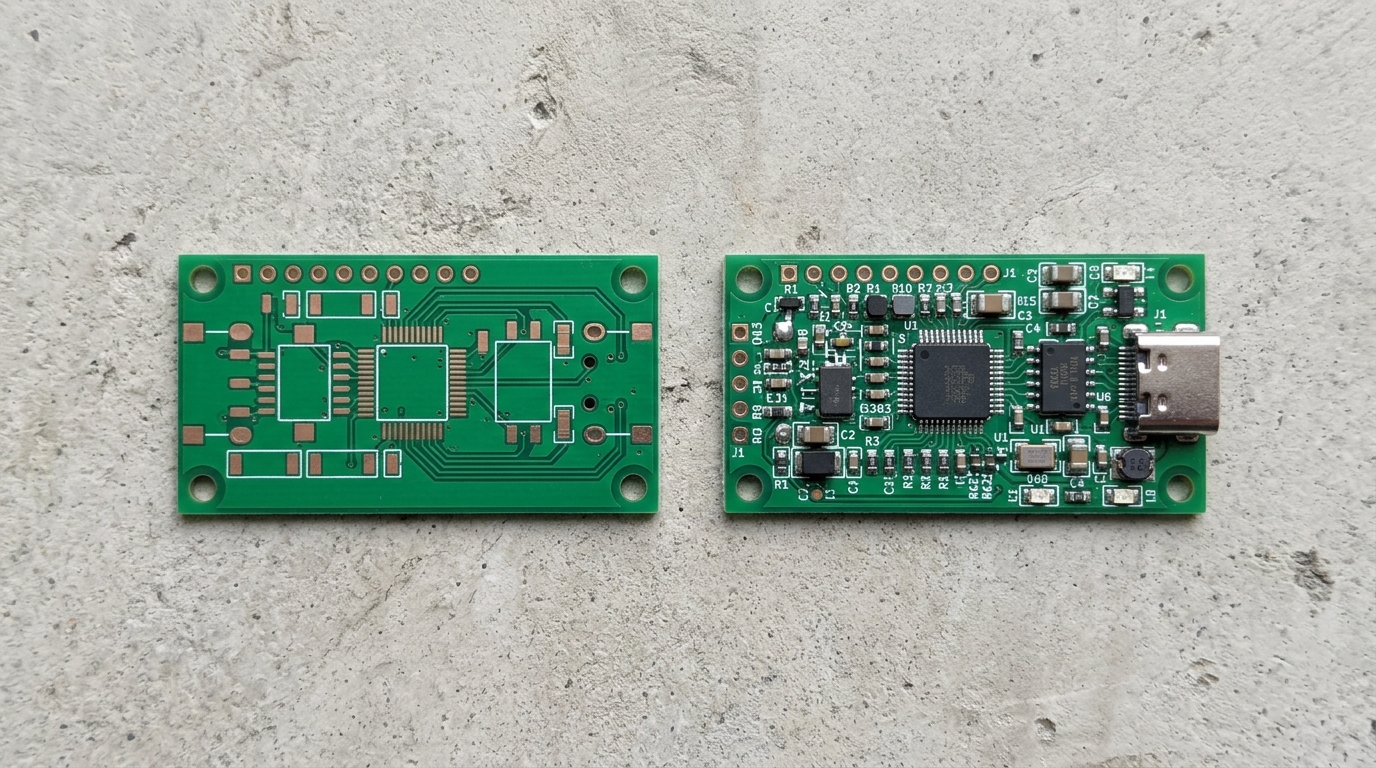
A bare board is the green rectangle on its own. Copper traces, drilled holes, solder mask, silkscreen, empty pads. It is a very cheap, very fast thing to make. Nothing on it does anything yet.
An assembled board is that same rectangle with every component soldered on by machine: the microcontroller, the regulators, the connectors, the eighty or so tiny resistors and capacitors. The shop buys the parts, prints solder paste through a stencil, places everything by machine, runs the board through a reflow oven and inspects it.
When you order bare boards, everything in that second paragraph becomes your job.
What a run of 5 costs
Bare boards at this quantity are almost free. A 2026 bare board price guide puts a standard 2-layer board under 100 by 100 mm at $2 to $10 each in a prototype batch, and a 4-layer board with a gold finish at $15 to $40 each. Five 2-layer boards is a $20 order plus shipping, and that is the number that makes people think hardware got cheap.
Assembled, the same five boards land somewhere between $87 and $350 each depending on who you ask, and the quotes genuinely do not agree. One assembly house's 2026 cost guide works a simple board at $87 per board for a run of 5: $60 of setup, $15 of labour, $12 of parts. A low-volume breakdown is far higher on setup, quoting $600 to $1,750 of one-off fees per job, which at five boards is $120 to $350 a board before the boards themselves at $20 to $80 each. That same source benchmarks a real wearable at about $100 a board at five units.
So: tens of dollars bare, a few hundred assembled. Both are true.
What a run of 50 costs
This is where it gets interesting, because the bare boards barely get cheaper and the assembled boards get much cheaper.
The same cost guide that worked a 5-board run at $87 works 50 boards at $24 each: $6 of setup, $8 of labour, $10 of parts. The low-volume source puts 11 to 50 units at $10 to $40 a board for something simple. A $600 setup fee that cost you $120 a board at five units costs you $12 a board at fifty.
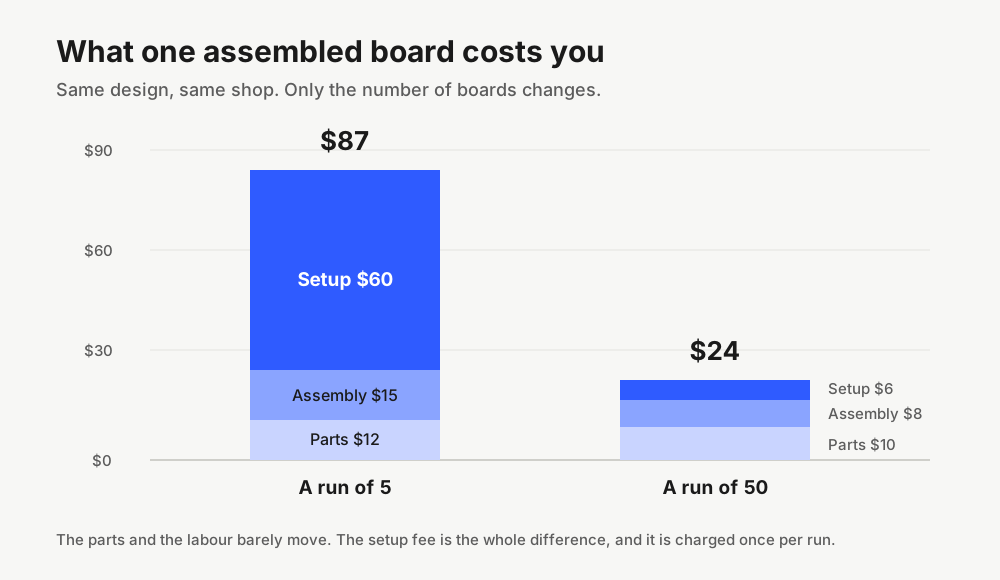
The same design at the same shop. The parts and the labour hardly move. The setup fee is the whole difference.
One breakdown puts the crossover plainly: for a typical stencil plus programming charge, the one-off fees stop being significant at around 80 boards. Below that, you are mostly paying for the privilege of starting the machine.
The setup fee is the whole story at low volume
Everything that happens once, regardless of how many boards you order, is lumped together as setup, tooling or NRE. In 2026 the pieces look like this:
- Solder paste stencil: $30 to $150. A frameless one for a prototype is at the cheap end, around $30 to $80.
- Programming the pick and place machine: $50 to $200.
- First article inspection, where somebody checks the first board properly before running the rest: $100 to $300.
- Panel tooling if your board outline is new: $50 to $200.
Nothing on that list is unreasonable. It is just all charged before the first board exists, which is why a quote for five looks insane and a quote for fifty looks sensible. The cheapest thing you can do to your budget is order more boards than you think you need: fifty of a simple design can cost less in total than two rounds of five.
What gets slower when you order assembled
Bare boards are fast. A prototype fabrication run is typically a few business days, and offshore bare boards can be done in about 24 hours.
Assembly adds real time. Standard lead time runs 10 to 15 days at the baseline price; pulling it in to 5 to 7 days costs 30 to 50 percent more, and a 24 to 72 hour turnaround roughly triples it. Offshore, assembly is 5 to 10 business days, then shipping and customs, which realistically means 6 to 10 days door to door and sometimes closer to two weeks.
There is a second clock, and it is the one that bites: parts. Nobody can start until every part on your list is in hand, and one part on back order holds the whole run. Order bare boards and you own that problem directly, which you find out about on a Tuesday when a reel does not arrive.
The part nobody warns you about: the pad underneath
Here is the thing that catches people, and it is the real reason I would not order bare boards for a first run.
Most modern chips are QFN packages, which have no legs. The connections are little pads along the edge of the chip, plus one big thermal pad in the middle of the underside. When the chip is sitting on the board, you cannot reach any of them with a soldering iron, because the iron has nowhere to touch.
Ask engineers who do this for a living and the answers are consistent. In an EEVblog thread on QFN solderability, one long-time poster calls soldering a QFN with an iron "extremely difficult" even with the right tip, another says 0.4 mm pitch is borderline unworkable by hand, and, worse, that the joints can look perfect and still not make contact. There are tricks involving a via drilled under the thermal pad so you can heat it from below, and people do get them to work, but one poster notes the catch: after that, the board is no longer compatible with normal machine assembly.
The consensus is that you want hot air at a minimum, and really you want solder paste, a stencil and something that heats the whole board evenly. Which means buying equipment:
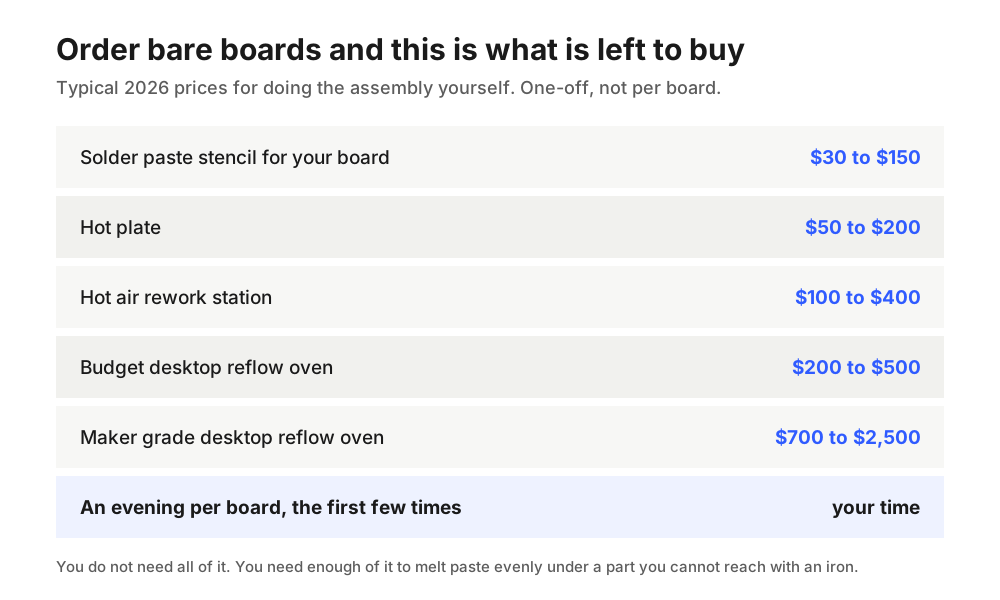
One-off, not per board. You do not need all of it, but you need enough of it to melt paste evenly under a part you cannot reach.
A hot plate is $50 to $200 and a hot air rework station is $100 to $400. A budget desktop reflow oven is $200 to $500, a maker-grade one is $700 to $2,500, and converting a toaster oven yourself is $50 to $200 and a weekend. Add a stencil for your specific board at $30 to $150.
Buy the cheap end of that and you have spent $150 to save $300 on a run of five, and added a skill to learn before you can test the thing you wanted to test. A good trade if you want the skill. A bad one if what you want is to know whether your idea works.
So which should you order?
Order bare boards when: your design is through-hole or larger surface mount packages with visible leads, you already own the gear, you are on a second or third revision of something you have assembled before, or learning is part of the point. Also when you want five boards today for twenty dollars and do not mind if two of them never work.
Order assembled when: there is a QFN, a BGA or any package with pads underneath, which on anything with a modern microcontroller or radio there will be. Also when you are showing the thing to somebody, when you need more than a couple of working units, or when the question you are answering is "does this design work" rather than "can I solder this".
And whichever way you go, check the board before you order it. A bare board run that comes back with a footprint wrong costs you twenty dollars and a week. An assembled run with the same mistake costs you the parts and the setup fee as well.
This is the fork everyone hits the week after they turn a dev board prototype into a real board, and it is worth deciding on purpose rather than by clicking the cheaper option.
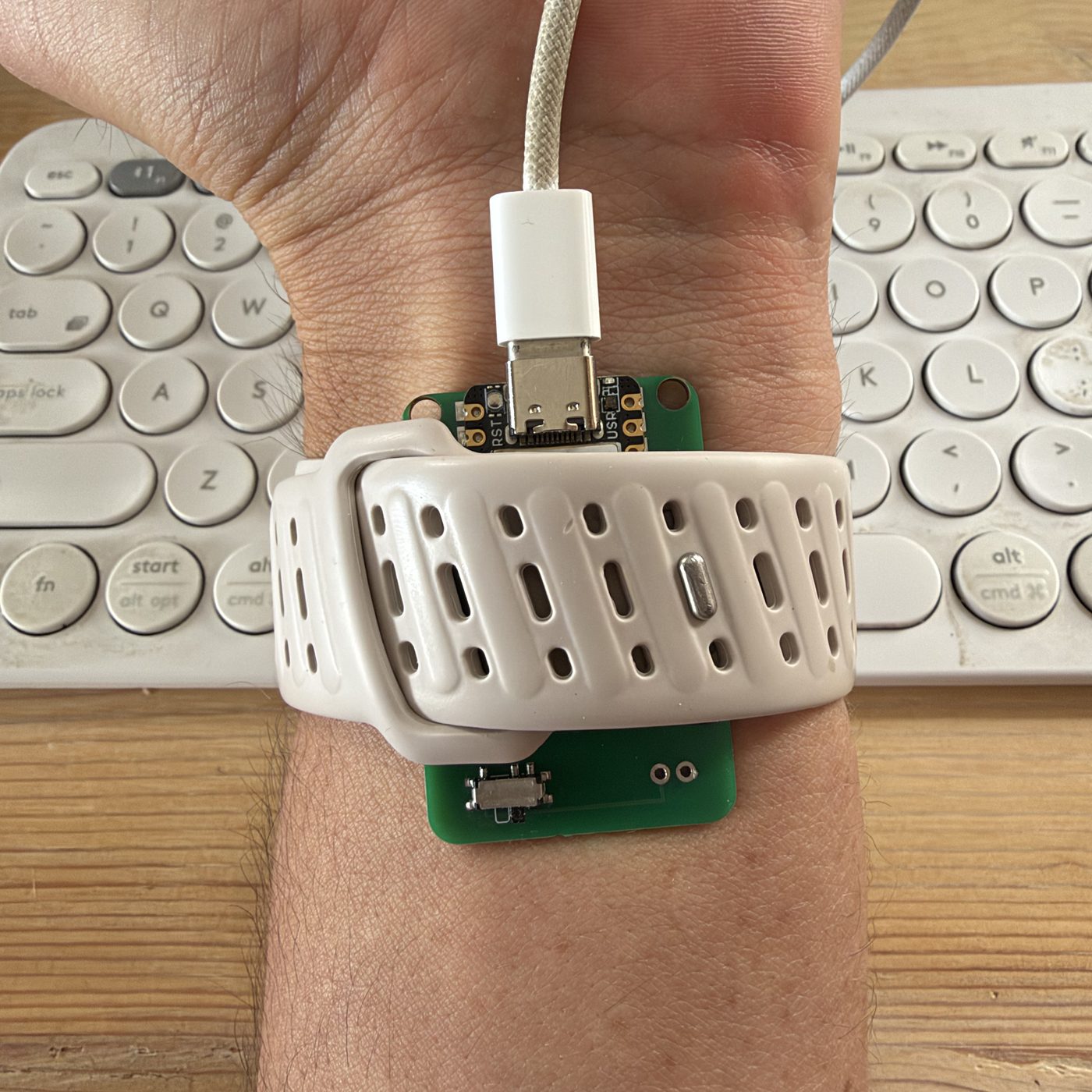
One of our own prototypes, assembled. This is the heart rate board from our firmware launch, which arrived with the parts already on it and worked on the bench the same day.
For what it is worth, this is the choice we took away at Tovan: you describe what you want, and the prototype that shows up is assembled, in a case, with the firmware on it. Ordering is a $99 fee plus the boards, parts, shipping and import duties at cost in one price, so there is no second invoice from a shipper or a customs broker. If you would rather take the design to your own shop, the manufacturing files and 3D models for a project are $79, and that comes off the order fee if you order later.
Frequently asked questions
Is it always cheaper to order bare boards?
Per board, yes, always. In total, often not, once you count the parts, the stencil, the equipment and your own evenings. And at a run of around fifty or more, the assembled price per board drops far enough that the gap stops being the deciding factor.
What is a reasonable minimum order quantity?
Most contract manufacturers will take a prototype order of 5 to 10 boards, and some will do a single unit. The constraint is rarely a hard minimum; it is that the setup fee makes very small runs look expensive.
Can I order bare boards and have somebody else assemble them later?
Yes, and it is common. Just do not do the trick of drilling a via under the thermal pad to hand-solder it, because that can make the board awkward for machine assembly afterwards.
Do I need a stencil if I am assembling by hand?
If you are placing anything with pads underneath it, effectively yes. You can get away with dispensing paste by syringe on larger parts, but a thermal pad in the middle of a chip needs an even, correctly sized deposit, and that is what the stencil is for.
How many boards should I order for a first run?
More than one and fewer than fifty. Five is the common answer, and it is a good one if you expect to change the design. If you are fairly confident and the board is simple, twenty-five will often cost barely more than five once setup is spread out, and it means you have spares when you break one.
The honest summary: bare boards are cheap because somebody still has to do the hard part. Work out whether you want that person to be you, and then order accordingly.
Sources: a 2026 PCB assembly cost guide (setup fees, placement costs, worked examples at 5 and 50 units, lead times), a low-volume assembly cost breakdown (per-unit tiers, NRE ranges, offshore and domestic timelines), a 2026 PCBA cost breakdown (stencil pricing and the point at which setup stops mattering), a 2026 bare board price guide (2-layer and 4-layer prototype pricing), and a 2026 reflow oven buying guide (hot plate, hot air and desktop oven prices). All read on 23 October 2026. Prices are what vendors publish as typical and will not match your quote exactly.
0 comments