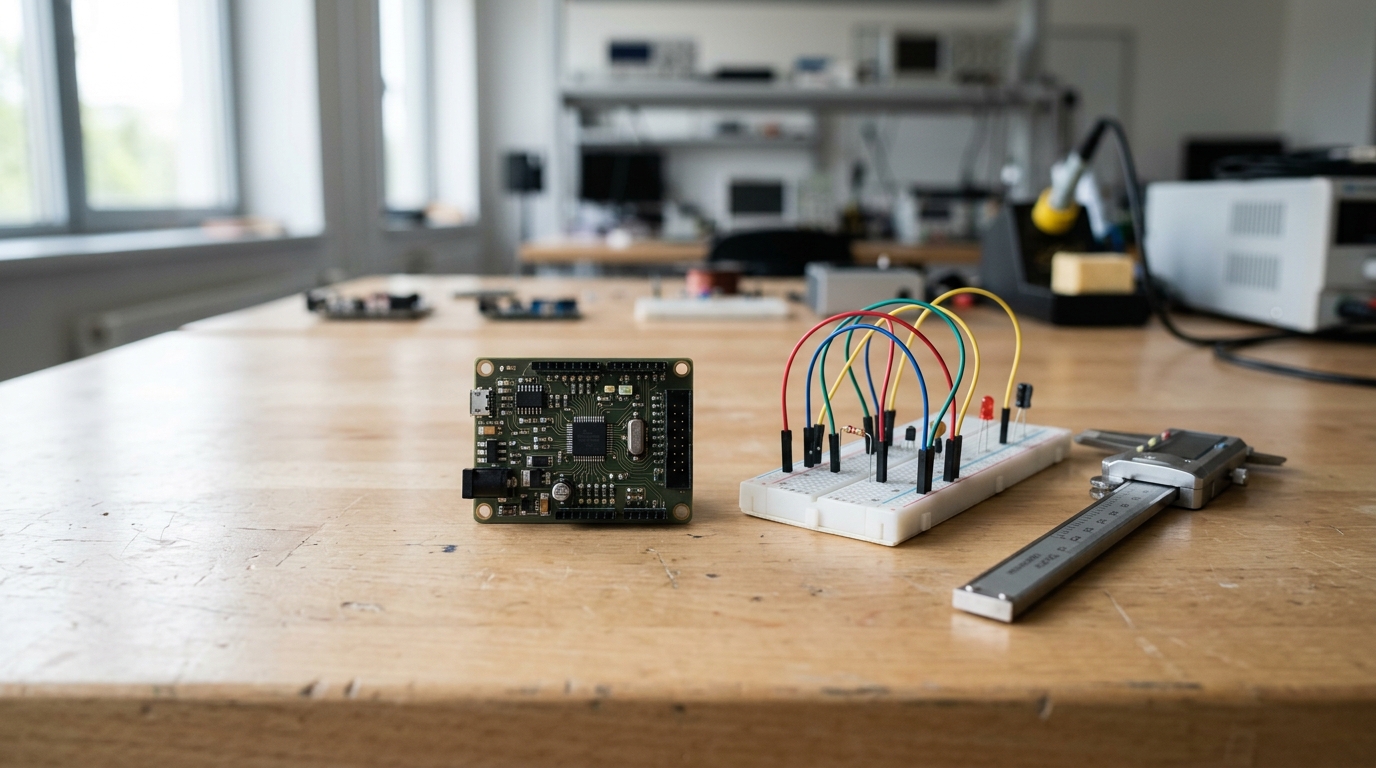
Most hardware proof of concept budgets die the same way. Someone decides the demo also has to look like a finished product, and three months later there is a beautiful enclosure wrapped around a circuit nobody has ever powered on in front of a customer.
A hardware proof of concept has one job: convince somebody that the idea works well enough to fund the next version. It does not have to be pretty. It does not have to be cheap at 10,000 units. It does not have to be certified. Below are the four routes teams actually take in 2026, with current prices and timelines for each, including the ones that compete with what I build.
The short version
- Dev board and jumper wires: $6 to $30 per board, working in days. Right when the demo stays on a table.
- An engineer you already employ: cheap on the spreadsheet, slow in reality, because you are in a queue behind shipping products.
- Freelancer or design firm: roughly $400 to $4,000 to design a simple 2-layer board, plus two to six weeks of calendar.
- AI design tools: around $20 a month plus fab costs, days instead of weeks, with hard limits on what they can take on.
- The physical hardware is the cheap part. Bare boards start near $2 for five, and a small assembly run adds about $10 in fixed fees.
What a hardware proof of concept has to prove
Before you pick a route, get specific about what this build is answering. Almost every overspend I see comes from proving something that nobody asked about yet.
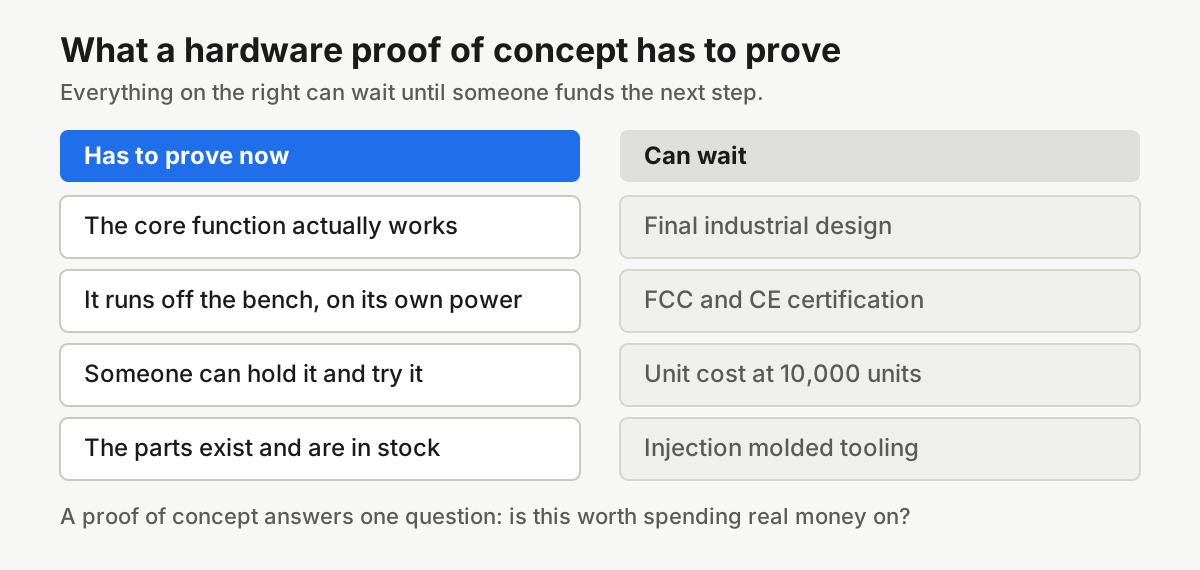
Write the question down before you spend anything. "Can this sensor detect a leak through a cabinet wall" is a proof of concept. "Does this look good on a shelf" is a different project with a different budget.
Option 1: dev boards and jumper wires
The cheapest honest answer. Buy a microcontroller board, wire up the sensors, write enough code to make it do the thing.
Current list prices: the Raspberry Pi Pico 2 starts at $5 and sells for $5.75 at SparkFun, the Pico 2 W with WiFi is $7, an Adafruit ESP32-S3 Feather is $17.50, and an Arduino UNO R4 WiFi is $27.50. Add sensors, a breadboard and wire and you are still under $100 for most ideas.
Where this breaks down: jumper wires fall out. The thing cannot survive a bag, a car ride or a customer picking it up. It tells you nothing about size, battery life or cost. And investors have seen a thousand breadboards, so it does not move anybody the way a small finished-looking prototype does.
If the dev board answered your question and now you need something you can hand to a person, that is a different step. I wrote about it in turning a dev board prototype into a real board.
Option 2: the engineer you already employ
If your company has an electrical engineer, this is the best quality per dollar you will find. Salary.com puts the average US PCB designer at $75,842 a year, about $36 an hour as of August 2026. Forty hours of schematic work is roughly $1,400 of salary, which is far less than any firm will quote you.
The catch is not money, it is the calendar. Internal EEs are attached to products that already have revenue and already have deadlines. Your proof of concept is, by definition, the thing with no revenue attached. I have watched "I will get to it next sprint" turn into a quarter more times than I can count.
The move here is to ask for a narrow slice instead of the whole build: two hours to review a parts list, or one afternoon to sanity check a power supply. You will get that. You will not get sixty uninterrupted hours.
Option 3: a freelancer or an outside design firm
Real numbers, since this is where the quotes get confusing. Cad Crowd puts freelancers at $30 to $100 an hour and design engineering firms at $90 to $145 an hour. A 2026 pricing guide from Circuit Board Design lists senior US, UK and EU engineers at $120 to $250 an hour and offshore teams at $30 to $60. Fiverr marketplace data lands in the middle at $40 to $85 an hour for electronics design engineers.
Per project, the same Circuit Board Design guide quotes a simple 2-layer board at $1,500 to $4,000 from a US or UK shop, $1,200 to $3,000 in the EU, and $400 to $1,200 offshore. A standard 4-layer board runs $4,000 to $10,000 from a US or UK shop. Cad Crowd's worked example for a full project, schematic through routing and design for manufacturing review, comes to about $25,200 across 252 hours, which is a useful reminder of what a real production design costs.
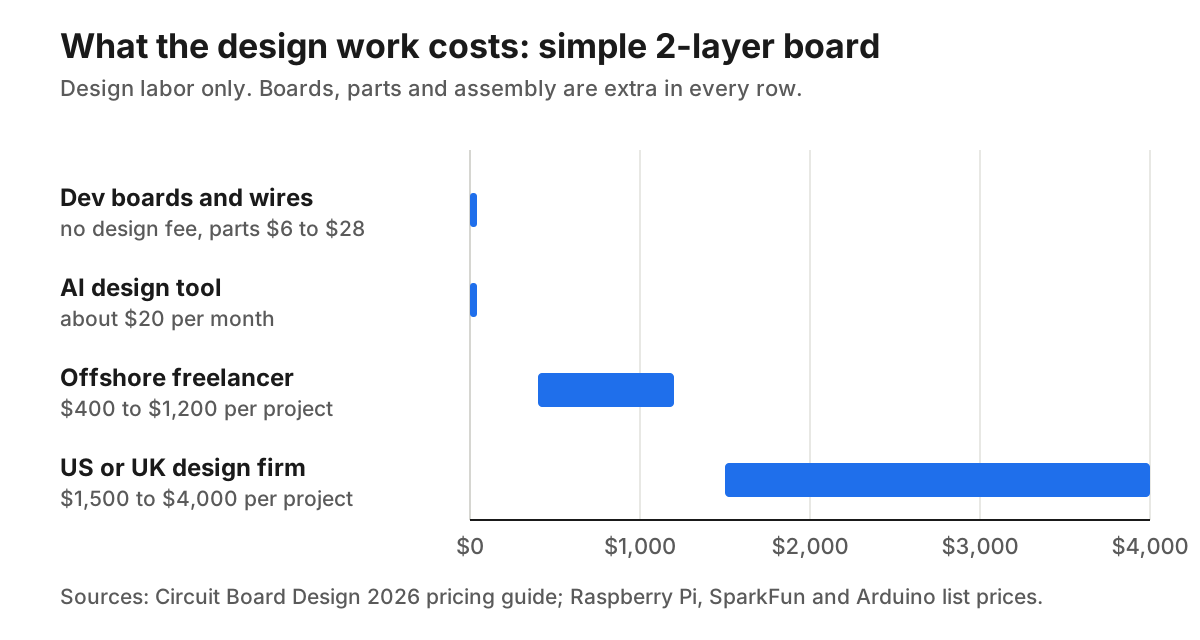
Timelines: that guide quotes 3 to 7 business days of design work for a 2-layer board and 10 to 14 for a 4-layer one. Add a week or two for the firm to actually start, plus a revision round, and a realistic answer is two to six weeks from signed quote to files.
When it is worth it: anything with RF, anything fast, anything with a real safety story, or a design you intend to certify and ship. Pay the engineer. Do not shop that work on price.
Option 4: AI design tools
This category barely existed three years ago. You describe the circuit in plain English, the tool picks in-stock parts, draws the schematic, lays out and routes the board, and runs design checks. Some also generate a 3D printable enclosure that fits the board, plus a bring-up guide for when the hardware shows up. Pricing sits in the subscription range rather than the project range. Tovan, which I build, is free to try and $20 a month for Pro.
The honest limits, and these matter more than the price:
- Firmware is usually still on you. Most of these tools do not write it. Update, October 2026: Tovan now writes and tests firmware for the boards it designs, in beta (here's how). Otherwise, a coding assistant will get you further than you expect on a microcontroller, but somebody has to own that code.
- Layer count is capped. Tovan tops out at 4 layers, which covers most sensor, power and connectivity prototypes and none of the dense ones.
- Not for RF-heavy or high-speed work. Antenna matching, controlled impedance and DDR routing are jobs for a human who does them all day.
- Not a certification path. If the design is headed straight into FCC testing, start with an engineer who has been through it.
Inside those limits it is fast and cheap, and the output is real manufacturing files rather than a picture. Outside them, one of the options above is the right call.
What the hardware costs, whichever route you pick
Design labor is the expensive part. The physical hardware usually is not, and founders consistently guess high here.
Bare boards: JLCPCB advertises prototype PCBs from $2 with a standard lead time of 2 to 5 days and a 24 hour express option.
Assembly: the published JLCPCB assembly price list shows an Economic PCBA setup fee of $8.18, a stencil at $1.53, and $0.0016 per solder joint. For five boards with sixty joints each, that is 300 joints, or about 48 cents of assembly labor, on top of roughly $10 in fixed fees. Hand soldering adds $3.58 per order. Standard PCBA setup is higher at $25.56 for one side and $51.12 for both. Parts are the variable that actually moves your total.
Enclosure: a service-printed FDM part for a small concept model runs roughly 5 to 25 euros, per a 2026 3D printing pricing guide, and ships in 3 to 5 days. If you own a printer, it is filament and an afternoon.
For the full picture across every line item, I broke it down in how much it costs to make a hardware prototype.
Picking your route
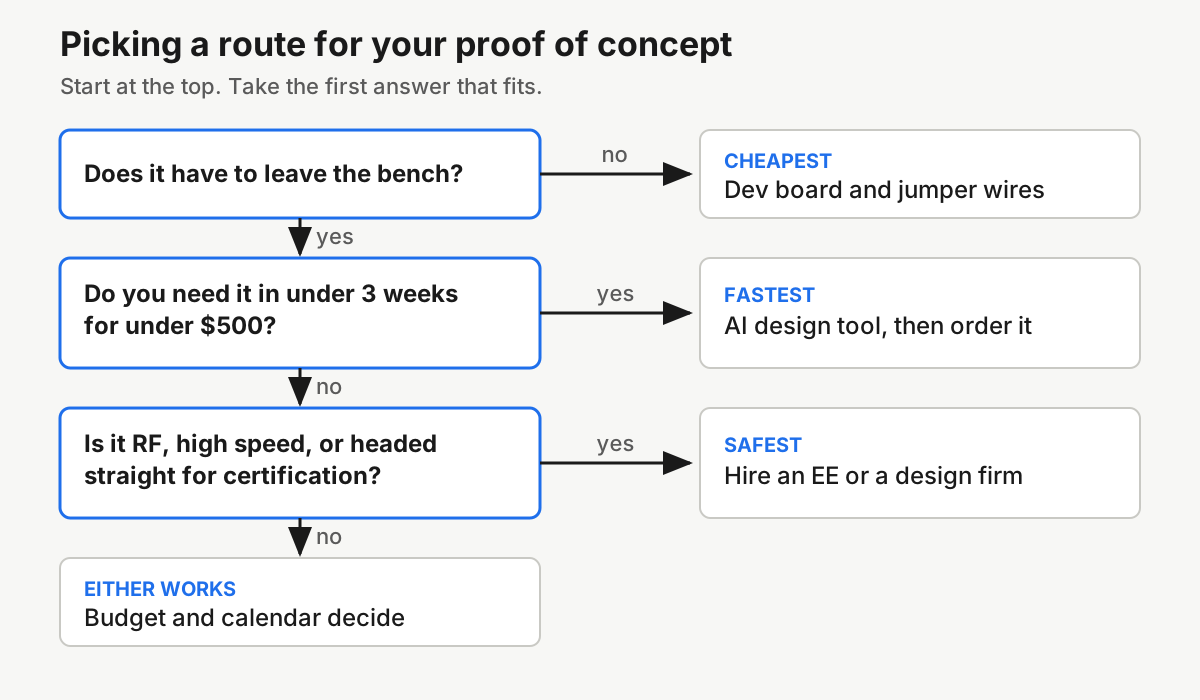
Most small-budget proofs of concept land in one of two places: a dev board on a table, or a small custom board in a printed case that somebody can hold. The second one costs a few hundred dollars more and is worth roughly ten times as much in a meeting.
Four ways small budgets get wasted
- Buying an enclosure before the circuit works. Industrial design on a circuit that might change is money you spend twice.
- Chasing certification too early. You certify the design you intend to sell, not the one you intend to throw away.
- Ordering fifty boards of revision A. Order five. You will find something. Everybody does.
- Treating firmware as free. It is usually the longest pole in the tent. Even with Tovan now writing and testing it in beta, budget real time to decide exactly what the product should do and to test it.
FAQ
How much should a hardware proof of concept cost?
For a simple sensor or power product, somewhere between $50 and $2,000 depending on route. Dev boards and parts land under $100. A custom board designed with an AI tool and manufactured in small quantity typically lands in the low hundreds. A freelancer or firm designing a simple 2-layer board starts around $400 offshore and $1,500 in the US or UK.
How long does a hardware proof of concept take?
Days with dev boards. One to three weeks if you design a custom board yourself or with a tool, mostly waiting on fabrication and shipping. Two to six weeks through a design firm, since the design work itself is only 3 to 14 business days and the rest is scheduling and revisions.
Do I need a custom circuit board for a proof of concept?
Not always. If the demo lives on a table and nobody needs to carry it, a dev board is enough. You need a custom board when size, battery life, durability or the way it feels in someone's hand is part of what you are trying to prove.
Can AI actually design a circuit board?
For a meaningful subset of designs, yes. Parts selection, schematic capture, layout, routing and design rule checks are all automatable today for low-layer-count boards. RF work, high-speed interfaces and certification strategy are not, and a tool that claims otherwise is overselling. Firmware is starting to be: as of October 2026, Tovan writes and tests it for the boards it designs, in beta.
Should I certify my proof of concept?
No. FCC and CE testing applies to the product you intend to market. Certifying a build you plan to redesign is money burned. What matters at this stage is designing in a way that does not paint you into a corner later, like using a pre-certified radio module.
How many boards should I order for a first run?
Five. Fabs price prototype runs at five anyway, you will kill one during bring-up, and you will want a second working unit so a demo failure is not the end of the meeting. Do not order fifty until a board has been powered on and tested.
What is the cheapest way to look credible to an investor?
A small custom board in a 3D printed case that does one thing reliably. It costs a few hundred dollars and reads as a product. A breadboard with the same circuit reads as a science fair, fairly or not.
Pick the route that answers your actual question, then stop. The next round of money is what pays for the version that looks like a product.
0 comments