
If you have to prove a hardware idea to somebody holding a budget, at some point you will ask what a hardware design firm costs and how long it takes. It is a fair question and a surprisingly hard one to get a straight answer to, because almost nobody publishes a price. You send a description, you get a call, and a few weeks later you get a statement of work with a number on it.
So here are the numbers that are published, where they come from, and what they actually buy you. I build a tool in this space, so I will be upfront about that and I will also be upfront about the cases where a design firm is the better call. There are several.
The short answer
For a powered consumer device with a circuit board in it, concept and proof-of-concept engagements at US studios tend to land between $8,000 and $25,000 and run 5 to 10 weeks. If the thing is connected, wearable, or anywhere near a regulated category, that goes to $20,000 to $60,000 and up, over 8 to 16 weeks. Those ranges come from one US design studio that publishes its concept pricing openly, which is rare enough to be worth citing.
If you only need the board designed, not the whole product, it is cheaper and faster. A standard four-layer board runs $4,000 to $10,000 at a US or UK studio, and senior engineers bill $120 to $250 an hour, according to a 2026 pricing guide published by a PCB design vendor. Freelancers sit lower, mostly $95 to $145 an hour, with some specialists at $300, per a freelance marketplace rate survey.
Every one of those numbers is design fees only. Parts, fabrication, assembly and shipping are on top.
What you are actually paying for
A statement of work from a design firm usually covers some mix of: requirements and architecture, component selection, schematic design, PCB layout, a design review, a fabrication and assembly run for a handful of boards, firmware, an enclosure, and bring-up, which is the part where somebody sits at a bench with your board and finds out what is wrong with it.
The two things people underestimate are the review and the bring-up. They are not padding. They are where the faults get found, and a firm that skips them is not saving you money, it is moving the cost to a place you will discover later.
Where the weeks go
This is the part that surprises people more than the price. Published per-stage estimates for electronics development, from a widely used hardware development timeline, look like this:
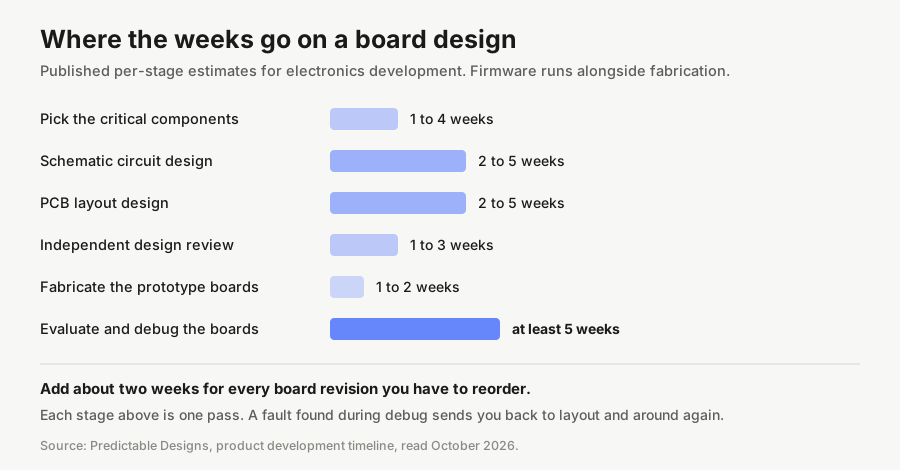
Add those up at the low end and you are at roughly 12 weeks before you have a board you trust, and that assumes one pass. The same source puts firmware at 1 to 6 months, running alongside the board work, and notes that every board revision you have to reorder adds about another two weeks.
So when a firm quotes you ten weeks, they are quoting the happy path. Ask them directly how many board revisions the quote assumes. The answer tells you more about the quote than the price does.
What a hardware design firm costs, by board
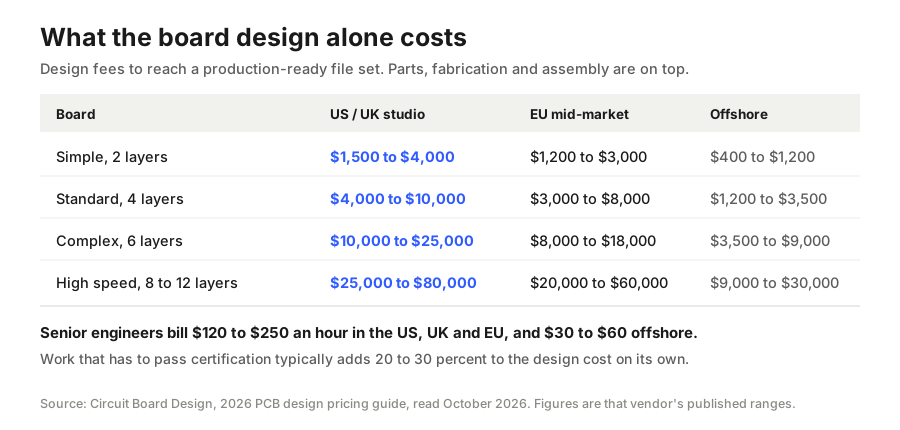
Two things to notice. The offshore column is genuinely much cheaper, often by three or four times, and plenty of people use it successfully. What you give up is time zone overlap and the ability to walk a half-formed idea through with somebody. For a first proof of concept, where the requirements are still moving, that matters more than it does on a well-specified redesign.
The other is that anything which has to pass certification adds 20 to 30 percent to the design cost before you have paid for a single test. If you are headed for an FCC mark, budget for it early. I wrote a plain-English guide to whether your device needs FCC certification that covers which products actually get caught by it.
What you own at the end
Get this in writing before you sign, because it varies a lot. You want the schematic, the layout source files, the bill of materials, the fabrication outputs and the firmware source, with no ongoing licence needed to use them. Some firms hand all of it over as a matter of course. Some hand over outputs but keep the source. Some keep the firmware.
If you cannot take the files to a different manufacturer or a different engineer next year, you have bought a prototype rather than a product, and the second version will cost you the first version price all over again.
When a design firm is genuinely the right call
There is a real line here, and it is not a close call on either side of it.
Go to a firm when the design is high speed, RF heavy, safety critical, or bound for certification. Go to a firm when the thing has to survive a specific environment that somebody has to sign off on, when you need an expert witness to your own engineering decisions, or when you are past proving the idea and into making ten thousand of them. These are jobs with real liability attached, and experienced humans who will put their name on it are worth what they charge.
Go to a freelancer when the board is well understood, you can write a tight spec, and you mostly need hands. That is the cheapest competent option on the list and it is underrated.
The case for not doing either is narrower than firms will tell you and wider than you might think: you are still working out whether the idea is any good, you need something real in front of a person with a budget in weeks rather than a quarter, and the device is not doing anything exotic.
The same two numbers for every option
Here is the honest comparison, using the same two numbers throughout, cost and calendar time to one working prototype.
- Design firm, full product: $8,000 to $60,000 and up, 5 to 16 weeks for concept work alone, longer to a tested board. Highest confidence, most hand-holding, the only sane choice for regulated or high speed work.
- Freelance engineer: $95 to $145 an hour, so roughly $2,000 to $10,000 for a straightforward board, plus your own time managing it. Timeline depends entirely on their queue.
- Offshore studio: $1,200 to $3,500 for a standard four-layer board. Cheapest professional route. Slower feedback loops.
- Do it yourself: the tools are free and the boards are cheap. The cost is the learning curve and the re-orders, which is the part nobody budgets for. I wrote about building a hardware proof of concept on a small budget if that is the road you are on.
- Tovan: you describe the device, it picks in-stock parts, designs the board and a custom-fit case, checks the design, and ships you the assembled prototype. Designing needs no subscription and comes with a free allowance of build credit that refills every week. Ordering is $99 plus the hardware at cost, with shipping and import duties in that one price. Design files for a project without ordering are $79, and that comes off the order fee if you order later. Up to four layers, and not for high speed, RF heavy or certification-bound designs, which is the line I drew above and I am not going to blur it.
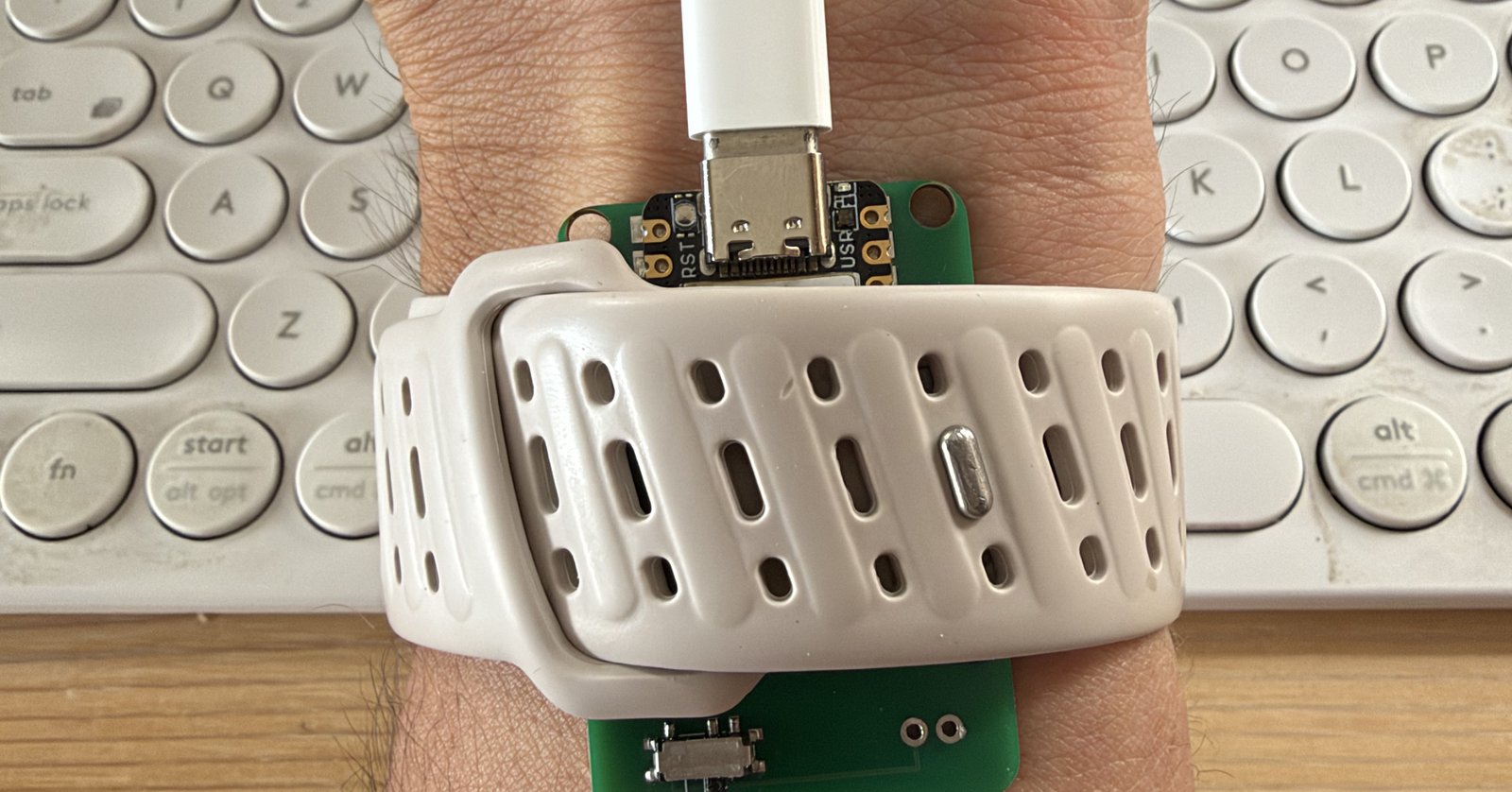
That board came from one plain request. It arrived assembled, and the firmware that runs on it was written and tested on the real hardware, which is in beta. I am showing it because a comparison like this one is cheap to write and easy to fudge, and a photograph of a thing that exists is harder to fudge.
For the full breakdown of what every line item costs on a first prototype, there is a 2026 cost breakdown here.
Frequently asked questions
How much does a hardware design firm cost for a simple device?
For a powered consumer device with a board in it, published concept ranges start around $8,000 and run to $25,000 over 5 to 10 weeks. Board design on its own is cheaper, from about $1,500 for a simple two-layer board at a US or UK studio.
Why do quotes vary so much for the same product?
Mostly because the scope is not the same. One quote includes firmware, an enclosure and bring-up, another is schematic and layout only. Ask every firm to price the same written list of deliverables, including how many board revisions are covered, and the spread usually shrinks a lot.
How long does it take to get a working prototype?
Roughly 12 weeks at the fast end for the electronics alone, if nothing goes wrong. Debug is the longest single stage at five weeks or more, and each reorder adds about two weeks. Anything that quotes you two weeks end to end is quoting fabrication time, not design time.
Is offshore PCB design worth the savings?
Often yes, if your spec is tight and stable. The published rates are $30 to $60 an hour against $120 to $250 in the US, UK and EU. The cost shows up as slower iteration, so it suits a well-defined board more than an idea you are still shaping.
Do I own the design files when the project ends?
Only if the contract says so. Ask for schematic source, layout source, the bill of materials, fabrication outputs and firmware source, with no licence needed to reuse them. Settle it before you sign, not at the handover.
The short version
A design firm costs five figures and takes a quarter, and for regulated, high speed or safety critical work that is money well spent. For proving an ordinary idea to somebody with a budget, the gap between what that costs and what you actually need has got a lot wider in the last two years. Price both, ask every quote how many revisions it assumes, and make sure you own the files at the end.
0 comments