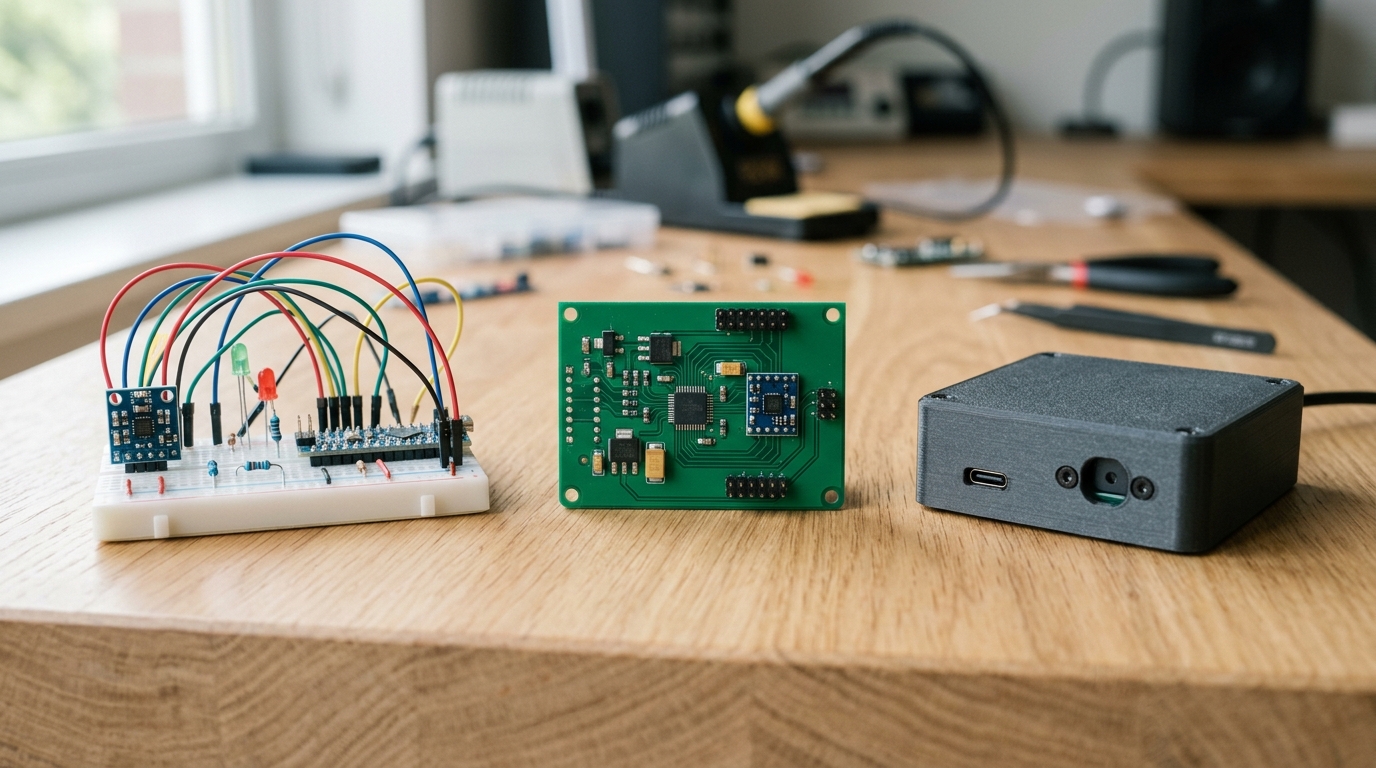
If you are writing up a hardware idea for someone who controls a budget, you have probably been handed one of three words: proof of concept, prototype, or MVP. They get used as if they all mean the same thing with different amounts of polish. They do not. Each one answers a different question, and the gap between proof of concept vs prototype vs MVP is the difference between spending forty dollars and spending forty thousand.
The most expensive mistake I see first-time hardware founders make is not a bad design. It is building the wrong stage: paying for molds and certification to answer a question that a pile of dev boards would have settled in a weekend.
The quick answer
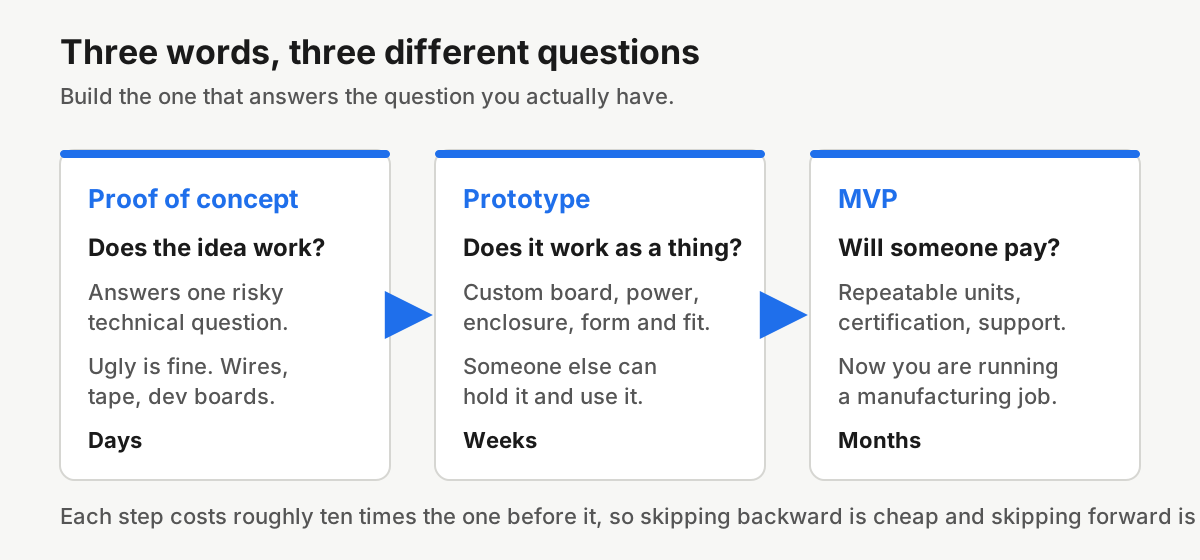
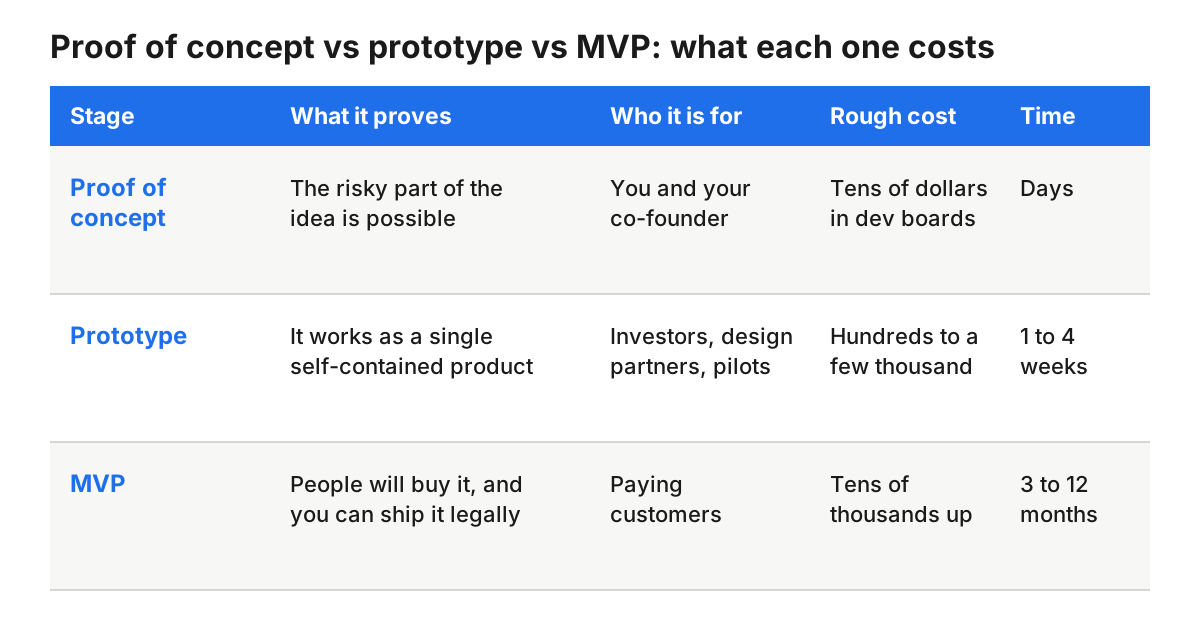
- Proof of concept: does the core idea work at all? One risky question, answered ugly. Days, tens of dollars.
- Prototype: does it work as a thing someone else can hold and use? Custom circuit board, real power, an enclosure. Weeks, hundreds to a few thousand dollars.
- MVP: will someone pay for it, and can you legally ship it? Repeatable units, certification, support. Months, tens of thousands.
If you are not sure which one you need, write down the question you are actually trying to answer this month. The question picks the stage, not your ambition and not the word your investor used.
Proof of concept: does the core idea work at all?
A proof of concept exists to kill or confirm one risky assumption. Not five. One. Can this sensor read through 2mm of plastic? Can this motor move that much weight on a battery? Will this radio reach across a warehouse? Pick the thing that, if it turns out to be impossible, means there is no product.
Ugly is not just acceptable here, it is the point. Jumper wires, a breadboard, a sensor module on a ribbon cable, tape. The hardware is scaffolding you throw away. A microcontroller dev board starts at around five dollars, and most sensor modules are a few dollars more, so a typical proof of concept lands somewhere between twenty and a couple hundred dollars depending on how exotic your sensor is.
What you should not do at this stage: lay out a custom circuit board, design an enclosure, worry about battery life, or argue about the shape. All of that is answering questions you do not have yet. I wrote a longer walkthrough of doing this cheaply in how to build a hardware proof of concept on a small budget.
Be honest about what you get: a proof of concept proves physics, not product. It will be too big, run off a wall adapter, and fall apart if you look at it wrong. That is fine. It cost you a weekend.
Prototype: does it work as a thing?
A prototype is the first version that is a product rather than an experiment. One custom circuit board instead of six modules on wires. Power that comes from inside it. An enclosure you can hand to someone who has never seen it before, and they can use it without you narrating.
This is the stage where fabrication costs enter, and they are smaller than most people expect. Bare circuit boards start at two dollars for five pieces with a 24 hour build time, and machine assembly starts at eight dollars, with a total order to delivery time of around three to seven business days. A 3D printed enclosure is similar: resin and nylon parts take 48 to 72 hours to print, and US-based services quote lead times from one to three business days by process.
The real cost of a prototype is not fabrication. It is parts, shipping, and the fact that you will do this two or three times. Nobody gets revision one right. Budget for the loop, not the single order. There is a full line-by-line breakdown in how much it costs to make a hardware prototype.
What a prototype does not prove: that it is manufacturable at volume, that it passes certification, that the battery number holds up over a month, or that anyone wants it. It proves the thing exists and works. That is already a lot.
MVP: will someone actually pay for it?
An MVP is not a nicer prototype. It is a small manufacturing operation. You are now making the same unit many times, which means consistency, test procedures, packaging, returns, and legal clearance to sell. The costs change shape completely, from dollars per part to thousands per decision.
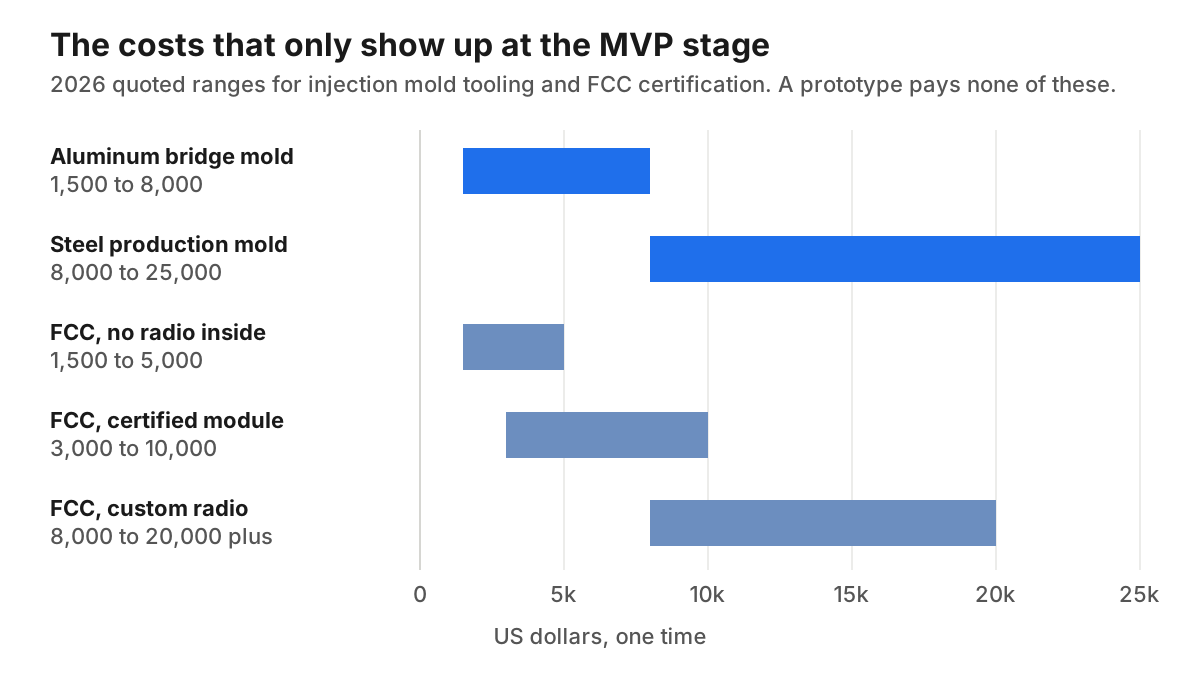
Enclosures are the clearest example. A 3D printed case costs you per unit forever. Injection molding flips that: an aluminum bridge mold runs 1,500 to 8,000 dollars with a two to three week lead time, a steel production mold runs 8,000 to 25,000 dollars over four to six weeks, and parts then come out at roughly 2.50 to 6.00 dollars each at a thousand units a year. Tooling is a bet that your design is finished.
Then certification. If your product has no radio in it, FCC compliance testing runs about 1,500 to 5,000 dollars over two to four weeks. Use a pre-certified radio module and you are looking at 3,000 to 10,000 dollars over three to six weeks, because the module vendor already paid for the hard part. Design your own radio and it is 8,000 to 20,000 dollars or more over six to twelve weeks. This single choice, module versus custom radio, moves your certification bill by five figures.
Assembly picks up one-time costs too. A stencil is 30 to 200 dollars, programming fees run 50 to 200 dollars, and an in-circuit test fixture is 2,000 to 8,000 dollars. Spread over five units those numbers are brutal. Spread over a thousand they disappear. That is the whole economics of the MVP stage in one sentence.
The common mistake: building an MVP to answer a proof of concept question
Here is the pattern. A team is confident in the idea, so they skip ahead. They hire an industrial designer, approve a shape, cut a mold, and order 500 assembled units. Then the first real test happens and the sensor cannot read reliably through the plastic they chose. Now the mold is wrong, the 500 units are wrong, and the question that broke them was a forty dollar question they could have answered in week one.
The rule I use: the cheapest version of a test is the correct version of that test. If a question can be answered with wires on a desk, answer it with wires on a desk. Spending more does not make an answer more true, it just makes being wrong more expensive.
The reverse mistake is real too, and quieter. Showing a breadboard to a retail buyer or a pilot customer does not get you a decision, it gets you a polite nod. Some audiences need to hold the thing. If your question is "will this customer commit", a proof of concept is the wrong answer and a prototype is the right one.
What changed recently: the middle step got much cheaper
For years the prototype stage was the real gate. Not because fabrication was expensive, since five circuit boards have cost about the price of lunch for a while now, but because the design work in between needed an electrical engineer. Schematic, part selection, layout, routing, a case that actually fits. That is weeks of specialist time, and specialists are booked out or expensive, usually both.
That gap has narrowed a lot in the past two years. Design tools now do a real share of the middle step, which means the jump from "it works on my desk" to "here is a thing you can hold" is no longer the moment a project stalls for a quarter waiting on a contractor.
Tovan is my attempt at that: you describe the product in plain English, it picks in-stock parts, draws the schematic, lays out and routes the circuit board up to four layers, generates a 3D printable enclosure that fits it, and lets you order the whole thing. It also now writes and tests the code for the boards it designs, which is in beta and only covers a specific list of microcontrollers. It is free to try, and it is the wrong tool for high-speed digital, RF-heavy, or certification-bound designs. If your product is a radio front end, hire a human.
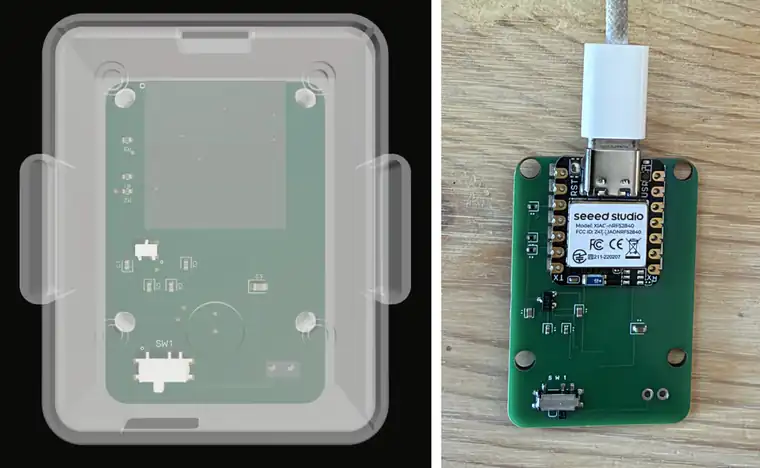
That is Tovan's 3D preview of a pulse monitor in its generated case, before anything was ordered, and on the right the same board after it arrived. Useful at the prototype stage, and it does nothing for your mold or your certification bill.
How to pick which one to build next
- Write the single question you need answered this month, in one sentence.
- Name who needs to believe the answer: you, an investor, or a paying customer.
- If the question is technical and the audience is you, build a proof of concept.
- If the question is "does this work as a product" and the audience is outside your company, build a prototype.
- If the question is "will people buy this at this price", and you already have a working prototype, start the MVP work. If you do not have a working prototype, you are not ready for this step no matter what the deadline says.
FAQ
Is a proof of concept the same as a prototype?
No. A proof of concept answers whether something is technically possible and can be a mess of wires on a desk. A prototype is a working version of the actual product: custom circuit board, its own power, an enclosure, something a stranger can pick up and use.
Do I need a custom circuit board for a proof of concept?
Almost never. Dev boards and sensor modules answer the question faster and cheaper. You need a custom board when size, power draw, cost per unit, or mechanical fit become the question, and that is the prototype stage.
Can I show investors a proof of concept instead of a prototype?
Sometimes, at the earliest stages, if the technical risk is the story. But most hardware investors want to see something that works unattended. A prototype answers "can this team ship" in a way a breadboard cannot.
How much does a hardware prototype cost in 2026?
Fabrication is cheap: bare circuit boards start at two dollars for five pieces and machine assembly starts at eight dollars. Parts, shipping, and the two or three revisions you will actually need are what set the real number, which usually lands in the hundreds to low thousands.
When do I need FCC certification?
When you start selling or marketing the product in the US, not while you are prototyping. Costs run from about 1,500 dollars for a device with no radio to 20,000 dollars or more for a custom radio design, and using a pre-certified radio module is the single biggest lever on that bill.
Can I sell a prototype?
Generally no, not as a product. Selling means certification, consistent units, and standing behind the thing when it fails. You can run a paid pilot or a design partnership with prototypes, which is a good way to get real money and real feedback before the MVP spend.
Is a hardware MVP the same as a software MVP?
The intent is the same, the cost of being wrong is not. In software you ship and patch. In hardware the mold, the parts order, and the certification report are all committed before the first customer, so an MVP is the most expensive stage to get wrong and the one worth most planning.
Three words, three different questions. Pick the question first and the budget mostly takes care of itself.
0 comments