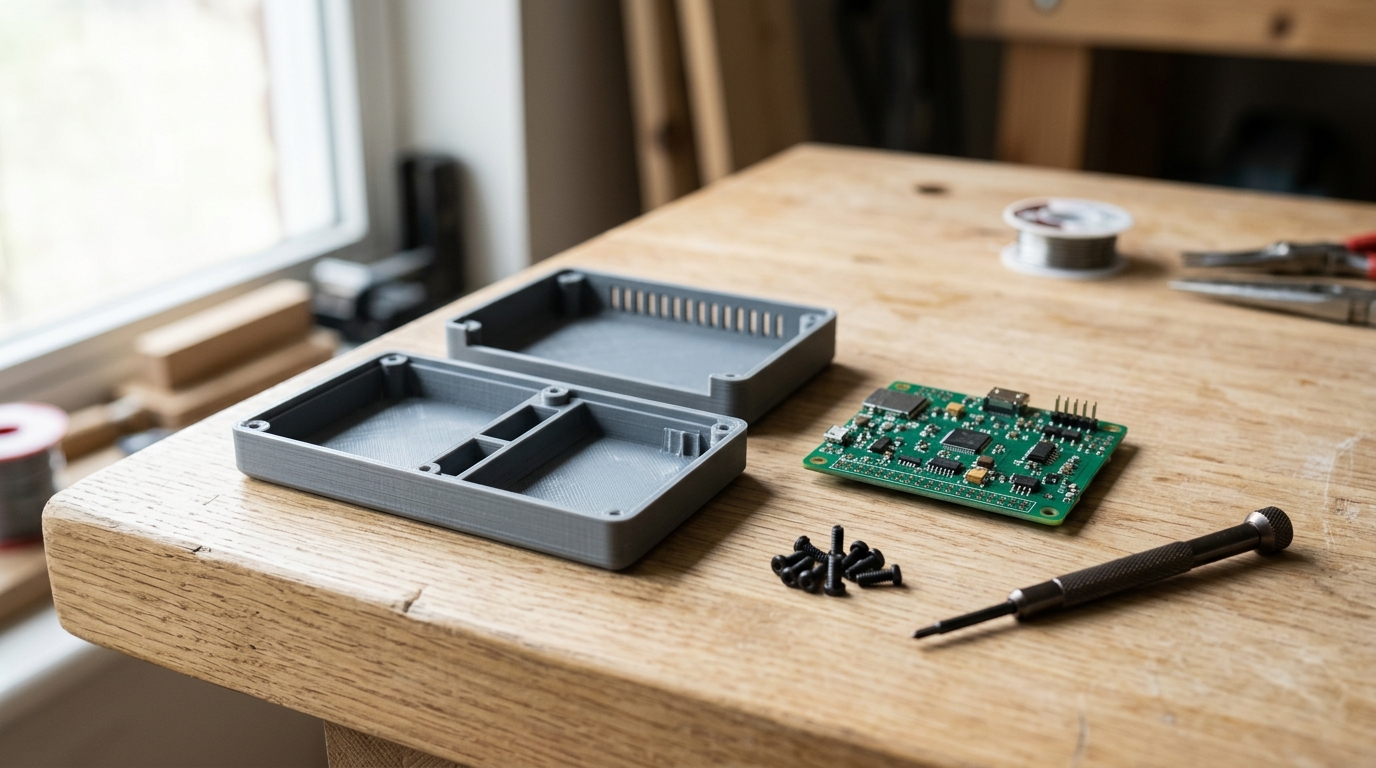
You got the board back, you plugged it in, and it works. The question everybody asks at that moment is whether to stop and make a case for it. A custom enclosure for a PCB prototype turns a bare green rectangle into something a person will pick up without flinching. It is also a side quest that can eat a week you did not have. So here is my honest take, with real numbers, on when a case is the right next move and when it is procrastination with a CAD file attached.
The quick answer
If you are the only person who touches the prototype and it lives on your bench, skip the case. Standoffs are fine. The moment somebody else holds it, or it travels in a bag, or it sits in front of a customer, you need an enclosure. Your choices then are an off the shelf plastic box for about 6 dollars that you drill yourself, modeling one in free CAD software, paying a freelancer 55 to 160 dollars an hour, or having it generated from the board you already designed. Injection molding is a later problem and costs thousands in tooling before you get a single part.
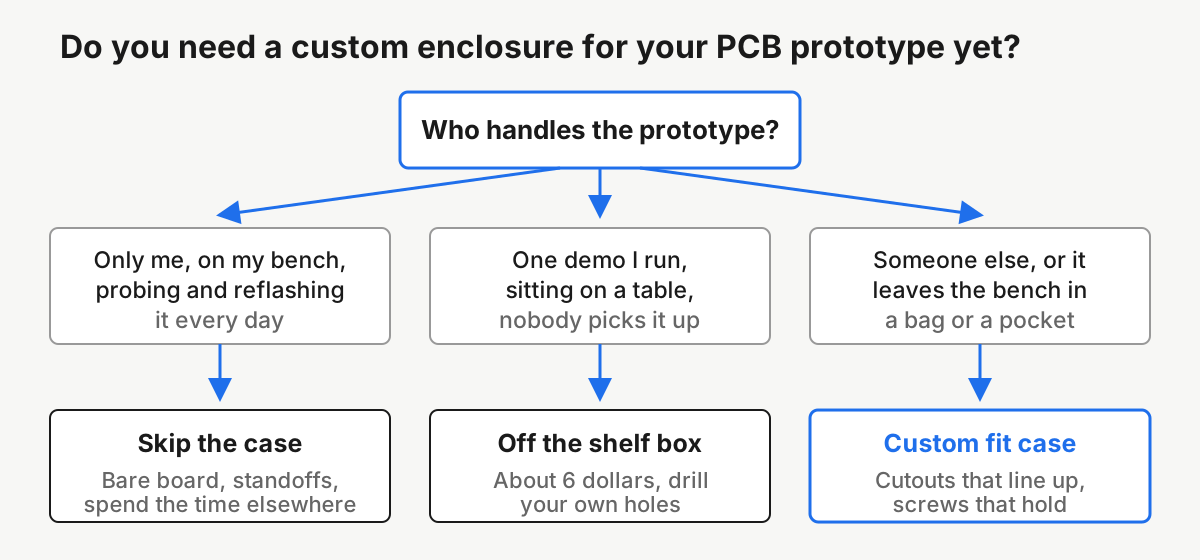
When you do not need one yet
A case locks things down, and early prototypes are not supposed to be locked down. If you are still doing any of this, a case slows you down more than it helps:
- Probing test points with a meter or a scope every day
- Swapping resistors, jumpering around a mistake, or cutting a trace
- Changing the board revision more than once a month
- Running it only on your own desk
Four nylon standoffs and four screws cost a couple of dollars and solve the only real problem a bare board has on a bench: sitting flat on something conductive. Spend the week on whatever is still uncertain instead.
When you do need one
There is a clean line, and it is not about how finished the electronics are. It is about who touches it.
You need a case when someone other than you handles the prototype: investors, a design partner, your first pilot customer. People do not evaluate a bare board the way they evaluate a product. That is not vanity, it is information. A bare board makes people ask whether this is real. A case in a slightly wrong shade of grey makes them ask how much it costs. Those are very different conversations.
You also need one when the prototype leaves the bench. Anything that moves adds failure modes that have nothing to do with your circuit: a connector levered sideways, a battery lead flexing until it breaks, lint across two pads. That is cheap insurance for a board that cost real weeks.
And you need one if it has to survive dust, splashes, a drop from desk height, or a user who will absolutely press the one thing you did not want pressed.
What a case actually has to get right
Most first enclosures fail on fit, not on looks. Five things carry almost all the risk:
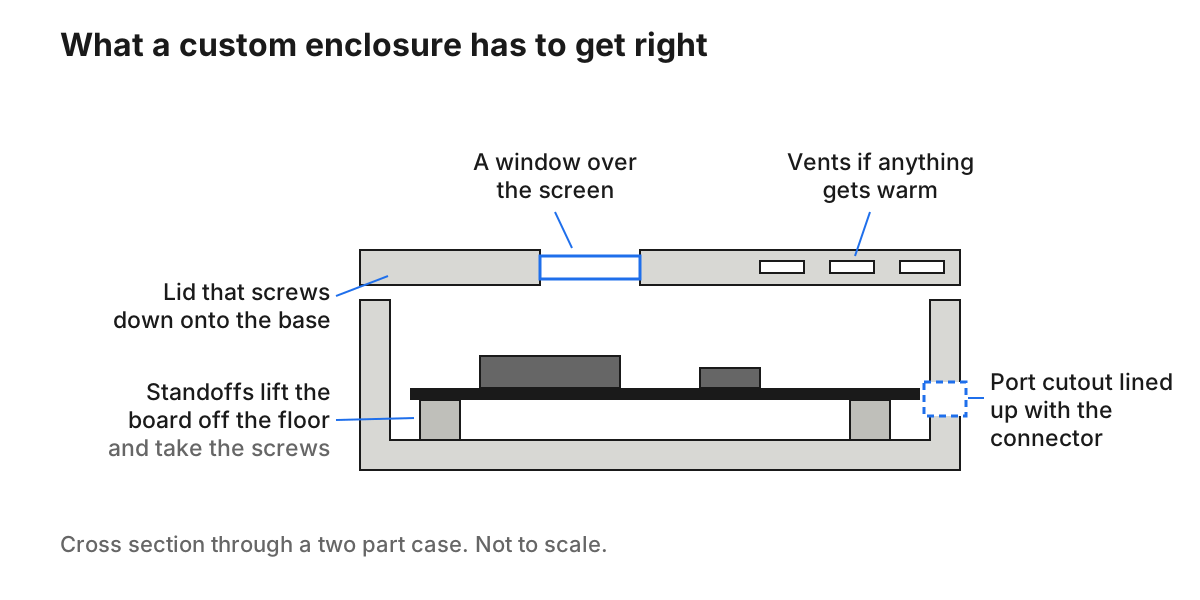
- Standoffs and screw bosses. The board has to sit off the floor of the case on posts that line up with its mounting holes, and those posts have to be tall enough to clear whatever is on the bottom side of the board. This is the single most common miss.
- Port cutouts. A connector sits at a specific height above the board, and that height plus the standoff height plus the wall thickness decides where the hole goes. Off by a millimeter and the cable will not seat.
- A window if there is a screen. A screen module has a visible area smaller than its outline, and the two are usually not centered on each other.
- Vents if anything gets warm. Regulators, motor drivers and charging circuits all dump heat. A sealed plastic box around them changes their behavior.
- A lid that closes. Fasteners need clearance, and two printed halves need a little slop or they will not go together.
None of this is hard engineering. It is bookkeeping, and it changes every time you move a connector.
Your four options, with real costs
Off the shelf plastic box
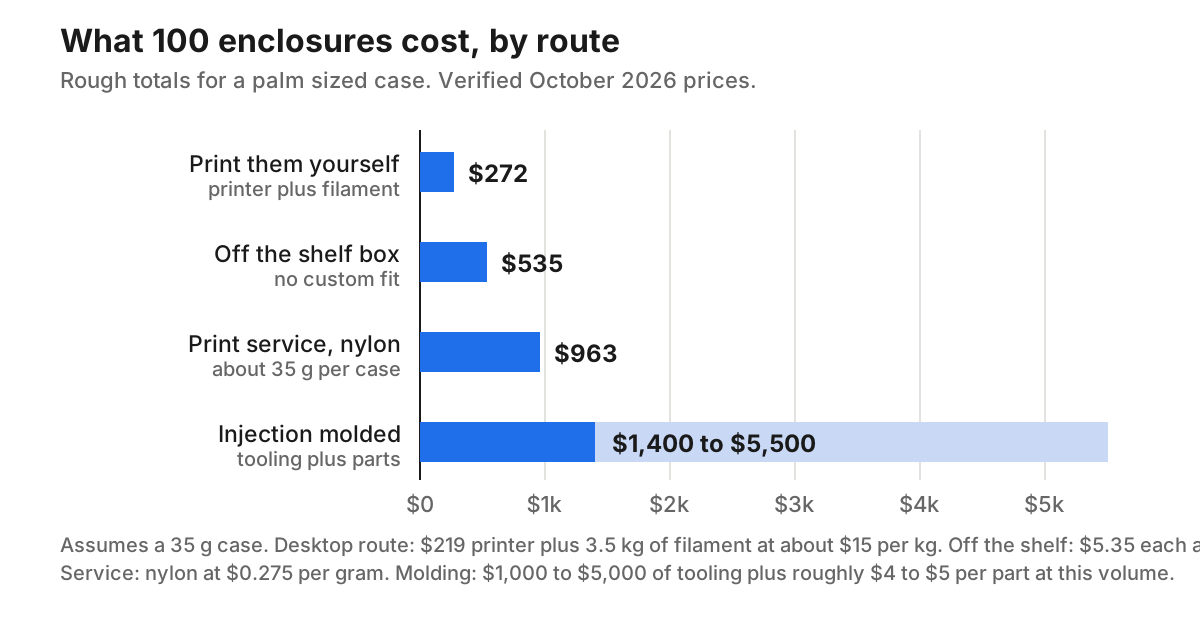
The fastest, cheapest path. A standard ABS box in the 4.7 by 2.6 by 1.4 inch range is about 5.85 dollars each, dropping to 5.15 dollars at 250 units, IP54 rated, with screws and PCB mounting slots included. It ships tomorrow.
The catch is that you are drilling and filing your own holes, and your board was not designed to fit this box. Ten units of hand drilled cutouts look exactly like ten units of hand drilled cutouts. Fine internally, rough for customer facing units.
Model it yourself
Autodesk Fusion is free for personal use on a renewable three year license, as long as you are non-commercial and making under 1,000 dollars a year from it. Past that it is 545 dollars a year or 68 dollars a month. Onshape and FreeCAD are other routes in.
The real cost is your time. If you have never done parametric CAD, budget a weekend to learn enough to place standoffs correctly, then another evening every time the board changes. I have watched founders spend three weeks here and come out with a case that fits and a product that did not move.
Pay someone
Freelance mechanical CAD runs 45 to 65 dollars an hour for junior work and 100 to 160 for senior. A simple single board case is usually a handful of hours, so call it 300 to 1,000 dollars for the first version.
That is real money, and the hidden cost is the loop. Every board revision means another email, another quote, another few days. The case is never quite in sync with the board.
Generate it from the board
If the thing that defines the case is the board, the case should come from the board. Where the USB port is, how tall the screen is, where the mounting holes are. That data already exists, and generating the enclosure from it means the cutouts cannot drift out of alignment, because nobody is retyping coordinates.
This is what we built into Tovan. You describe the product in plain English, it picks real in-stock parts, draws the schematic, lays out and routes the board, and then generates a custom fit 3D printable enclosure around that exact board, with the standoffs, cutouts, window and vents placed from the real geometry. You see the board sitting in the case in 3D before you order anything, and it also writes the firmware for the board, which is in beta. Free to try, Pro is 20 dollars a month.
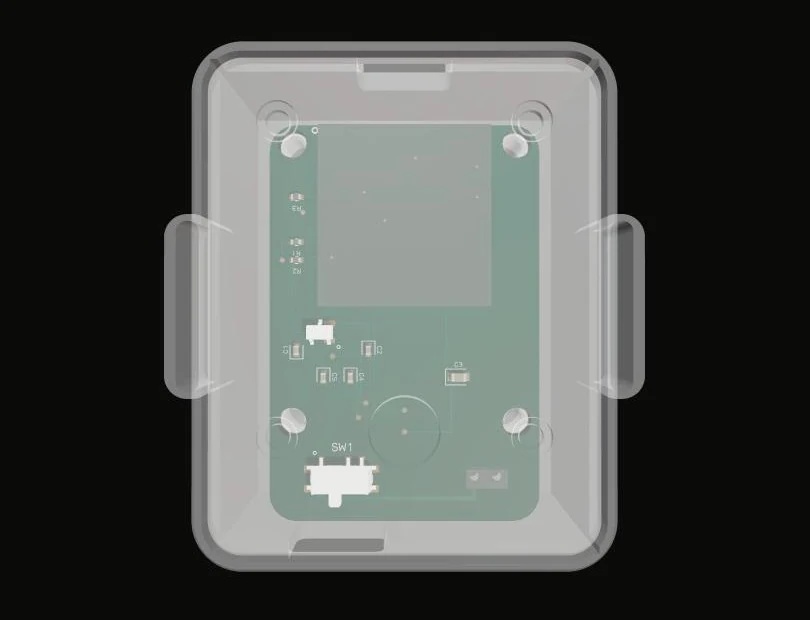
Tovan's 3D preview of the case it generated for a wrist-worn pulse monitor, with standoffs and strap loops placed from the real board.
The honest limit: what you get is a model for 3D printing, which is prototype tooling. It is not an injection molded part, it does not have the surface finish of one, and it is not a certified housing. It is also not the tool for high-speed, RF-heavy or certification-bound designs.
Printing it: yourself or a service
A desktop printer that does this well now costs around 219 to 299 dollars, and PLA filament is a commodity at roughly 15 dollars a kilogram. A palm sized case is maybe 35 grams, about 50 cents. The printer pays for itself on iteration alone, because your first case will be wrong and you will want it reprinted that afternoon, not next week.
A print service makes sense if you want a finish you cannot get at home. Resin starts from 0.30 dollars per part on a 2 day build, nylon from 1.00 dollar on a 3 day build, before shipping. Nylon at 0.275 dollars per gram puts that 35 gram case near 10 dollars. US services quote 3 day lead times for most SLA, SLS and MJF materials, faster but a lot more per part.
Where injection molding comes in, and why not yet
People ask about molding far too early. The economics are brutal: you pay for the tool before you get a part.
A small simple single cavity mold runs 1,000 to 5,000 dollars, a typical hand sized part around 12,000, and complex multi cavity tooling 60,000 and up. Lower volume aluminum tooling can come in from a few hundred to about 1,000 dollars, with per part prices around 4 to 5 dollars at low volume and 1.75 at high volume. Mold build is typically 4 to 12 weeks.
Molding wins on unit price and loses badly on flexibility. Every change after the tool is cut costs money. The crossover sits somewhere in the high hundreds to low thousands of units, and only after your design has stopped changing. If you are not sure the geometry is final, you are not ready, and the real risk is not the 3,000 dollars, it is the eight weeks you cannot take back. Our prototype cost breakdown has more on where the money goes at each stage.
What I would actually do
- Bench only, board still changing: standoffs, no case, zero dollars.
- Five to ten units going to other people: generate or model a case and print it. Expect version one to be slightly wrong. Under 300 dollars including the printer.
- A hundred units in the field: still printed, possibly through a service for consistency, roughly 300 to 1,000 dollars.
- Thousands of units, design frozen: talk to a molder, budget thousands plus two months.
FAQ
Do I need a custom enclosure for my first prototype?
Usually no. If you are the only person handling it and it stays on your bench, standoffs are enough. Make a case when someone else needs to hold it, or it leaves the bench.
How much does a custom 3D printed enclosure cost?
In material, almost nothing: a palm sized case is around 35 grams of filament, roughly 50 cents at 15 dollars per kilogram. Through a print service, nylon works out near 10 dollars a part. The real cost is design time or the printer, not the plastic.
Is a 3D printed case good enough to show a customer?
Yes, for a prototype or a pilot. Printed parts show layer lines and are not as smooth or as strong as molded ones, but a well fitted printed case reads as a product. A hand drilled generic box does not.
When should I switch from 3D printing to injection molding?
When the design has stopped changing and you need high hundreds to low thousands of units. Before that, tooling of 1,000 to 12,000 dollars and a 4 to 12 week mold build buy you nothing but risk.
Can I just buy an off the shelf enclosure and drill it?
Yes, and for internal test units it is the right call. A standard ABS box is under 6 dollars and ships immediately. It will not fit your board properly and the holes will look hand made, so keep it away from customer facing units.
What usually goes wrong on a first enclosure?
Fit, not aesthetics. Standoffs at the wrong height or in the wrong place, port cutouts a millimeter off, a screen window that does not line up with the visible area, no clearance for the fasteners, and no vents around anything that gets warm.
Do I need to learn CAD to get a custom case?
No. Pay a freelancer at 45 to 160 dollars an hour, or generate the case from the board itself. Learning CAD is worth it if you expect to iterate on mechanical design for years, and a waste if you need one box this month.
A case is not decoration. It is the difference between showing someone a circuit and showing them a product. Just build it because someone is about to hold your prototype, not because the board is done and the case is the next thing you know how to do.
0 comments