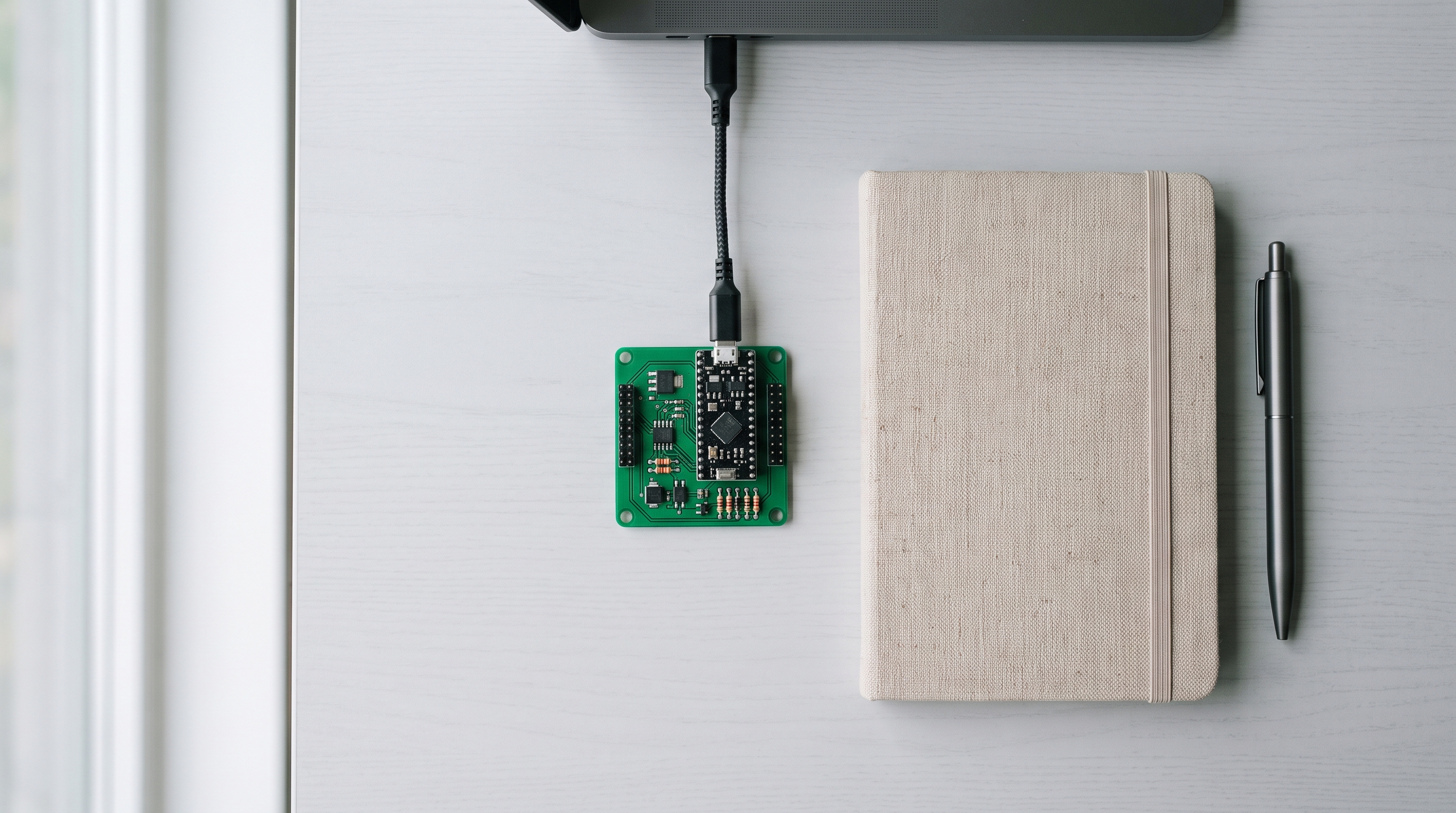
If you have a custom board on the way and nobody lined up to write the code for it, the first number you need is the one almost nobody publishes. Embedded firmware development cost in 2026 lands between roughly $2,000 and $20,000 for most first products, and past $40,000 once certified safety work is involved. That is the firmware engineering on its own: no hardware, no enclosure, no certification fees, no app.
The useful thing is not the range. It is knowing how the number gets built, so you can estimate your own before you ask anyone for a quote and so you can tell a fair quote from a guess. That is what this post is for. If you are still deciding who should write the code, start with Who Writes the Firmware for Your Custom PCB? and come back here for the money.
The short answer
Published 2026 vendor bands for firmware engineering, before any hardware:
- Bare metal, one job. A sensor that reads something and reports it over Bluetooth or WiFi: $2,000 to $5,000.
- RTOS application. Several things happening at once with timing that has to hold: $4,000 to $12,000.
- Embedded Linux with a board support package and drivers. $8,000 to $20,000.
- Each feature on top. Updates over the air, a cellular modem, LoRaWAN, device security: $2,000 to $10,000 each.
- Certified safety work. Two to three times the base, commonly past $40,000.
Hourly, the same guides put US and Western European engineers at $100 to $180, Eastern Europe at $45 to $90 and India at $25 to $60, with a 20 to 40 percent premium for radio, real-time and functional-safety specialists. Typical schedules run 4 to 16 weeks. Sources: Rapid Circuitry and GMware, both 2026. Treat them as vendor published bands rather than survey data, which is exactly what they are.
One number for scale on the other side of the fence: ZipRecruiter puts the average salaried US embedded firmware developer at about $109,000 a year as of August 2026, which is roughly $53 an hour before overhead. A contractor quoting $150 an hour is not three times better. They are carrying their own overhead, their own downtime and your schedule risk.
What you are actually paying for
Firmware on a first board is four jobs, and only one of them is the one people picture.
- Bring the chip up. Clocks, power, memory, a way to get code onto the board and a way to see what it is doing. Nothing visible happens here and it still has to happen.
- Talk to every part. Each sensor, display and radio has its own conversation, its own register map and its own undocumented quirk on page 47 of the datasheet.
- The behaviour. What the product does. This is the part you can describe in a sentence, and it is usually the smallest slice of the bill.
- Prove it on the real board. Not on a dev board on a desk. On your board, with your power supply, your layout and your parts.
When a quote comes back higher than you expected, it is almost always jobs one, two and four. The behaviour was never the expensive part.
Start from a base, then add what your product needs
The cleanest way to estimate your own firmware cost is to pick a base and add the features on top, because that is how the work actually divides.
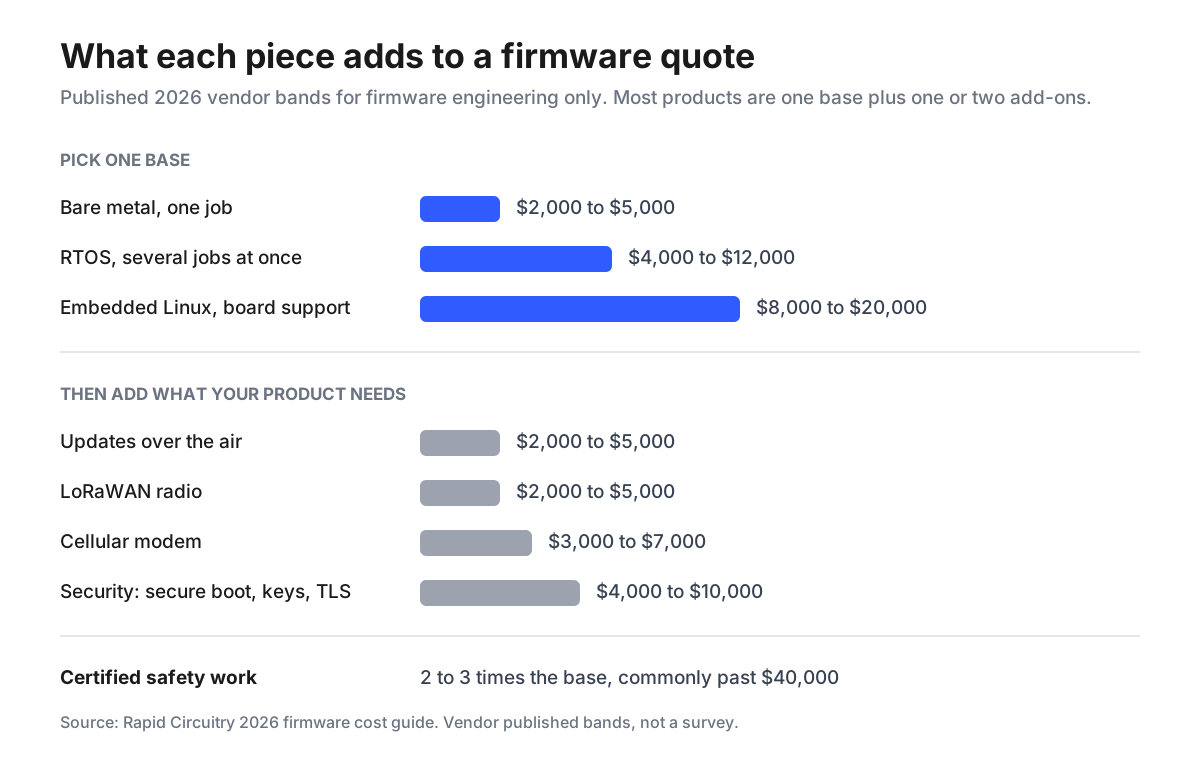
Most first products are one base plus one or two add-ons. A battery sensor that reports over WiFi is bare metal. The same sensor that also has to update itself in the field is bare metal plus over-the-air updates. A device that has to hold a video stream steady while it talks to a server is not bare metal at all, and the quote will say so.
Two add-ons are worth singling out. Over-the-air updates look like a nice-to-have and are the one that saves you later, because without them every fix is a recall or a visit. Security, meaning secure boot, key storage and TLS done properly, is the one people cut first and regret most, and at $4,000 to $10,000 it is often the single largest line after the base.
Rates, and what they actually buy
Rates vary by region more than by anything else. A 2026 rate survey from Developex puts senior US embedded engineers at $120 to $180 an hour, Western Europe at $90 to $130, Poland and Romania at $65 to $90, and India and Vietnam at $40 to $70.
The trap is reading that as a four times saving. It is not, for two reasons. The first is that the hours are not the same hours: a specialist who has shipped three products on your radio will spend a day where a generalist spends a week, which is what the 20 to 40 percent specialist premium is really buying. The second is that firmware is a conversation. Every question that waits overnight for an answer is a day added, and on a 6 week project a dozen of those is a different project. If you go offshore, budget for overlap hours, not just for the rate.
The costs that are not in the quote
The quote covers the engineer. It does not cover these, and this is where first products slip.
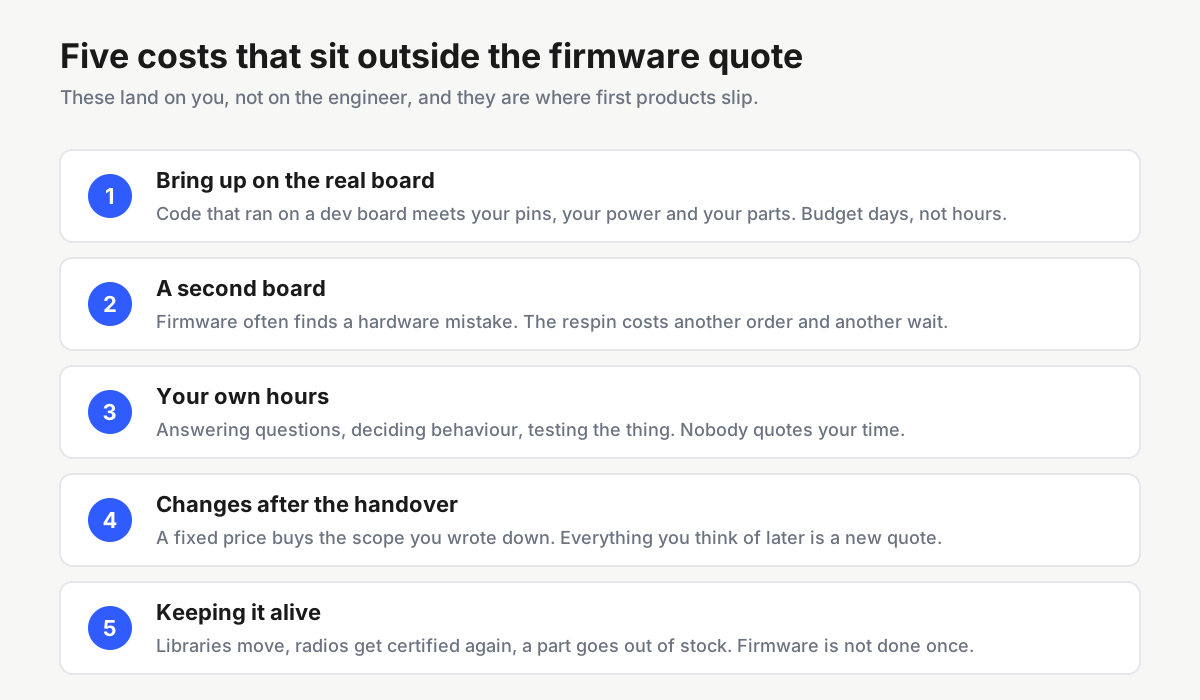
The second board deserves a paragraph of its own. Firmware is the first thing that tests your hardware honestly, so it is the first thing that finds the pin you swapped, the pull-up you left off and the regulator that browns out when the radio transmits. A respin is another order and another wait, and on a first board the wait is usually measured in weeks rather than days. If your budget has exactly one board in it, your budget is optimistic.
Testing on real hardware is also the step that gets skipped when money is tight, and it is the step that catches the things nobody predicted. In our own firmware launch, the test run found that a sensor was sampling 52.65 times a second rather than the 50 it was configured for, which is the kind of thing that never shows up in a code review and quietly ruins a measurement.
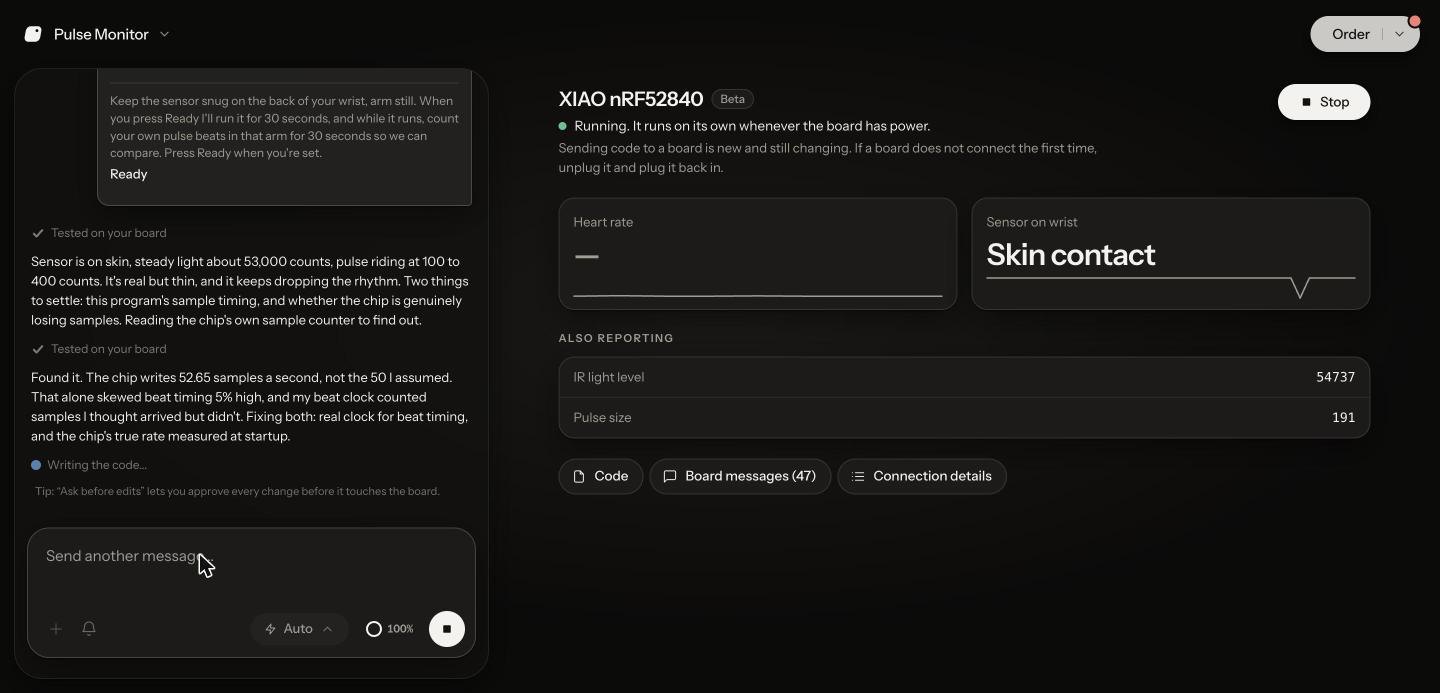
From our own firmware launch: the measured sample rate came back at 52.65 Hz rather than the configured 50 Hz. Found by running the code on the real board, not by reading it.
A worked example
Say you want a plant moisture sensor that reports to your phone over WiFi and can be updated in the field. Here is the estimate, built the way above:
- Base, bare metal with a WiFi stack: $2,000 to $5,000
- Updates over the air: $2,000 to $5,000
- Firmware engineering subtotal: $4,000 to $10,000
- Bring-up on your board, if it is not in the quote: a few days of someone's time
- One respin, which you should assume: another board order and 1 to 3 weeks
- Your own hours answering questions and testing: not billed, still real
So the honest answer for a simple connected sensor is four to ten thousand dollars of engineering, a board you will probably build twice, and six to twelve weeks. If someone quotes you $1,200 for all of it, they have either misunderstood the device or they are planning to hand you something that compiles and does not work.
How to make the number smaller
Four things actually move the cost, in order of how much they move it.
- Decide the behaviour before you ask for a quote. Not the features. The behaviour: what it does when the sensor fails, what happens when power drops mid-write, what the light means. Vague scope is the single biggest reason two quotes for the same device differ by three times.
- Cut what is not the point of version one. Over-the-air updates, a companion app and a cloud backend are each a real line item. If the question you are answering is whether the thing works at all, they can wait.
- Settle the behaviour on a dev board first. Code written against a dev board does not transfer for free, but the decisions do, and decisions are what you are paying an engineer to extract from you. Going from a dev board to a custom board is its own step with its own gotchas.
- Keep the board and the code in one place. A large share of firmware hours goes into reconciling what the schematic says with what the code assumes. When the same tool knows the pinout, that reconciliation does not happen.
That last one is the part Tovan does: you describe the device, it designs the board and the case, writes the firmware for the board it just designed and tests that firmware on the real hardware over a USB cable. Firmware is in beta and it is not magic, but it does remove the handover where most of the cost hides.
FAQ
How long does firmware for a simple custom board take?
Published guides put typical firmware projects at 4 to 16 weeks. A simple sensor sits at the low end, assuming the hardware works. Add a respin and the calendar, not the invoice, is what moves.
Why do two quotes for the same device differ by three times?
Almost always scope. The cheap quote is pricing the behaviour you described. The expensive one is pricing bring-up, part by part integration and testing on real hardware as well. Ask both what happens the first week the board arrives and the difference usually explains itself.
Is it cheaper to supply the hardware design myself?
Slightly, and only if the design is finished and correct. If the firmware engineer has to find your hardware mistakes, you are paying firmware rates for hardware debugging, which is the most expensive way to buy it.
Can AI write it and cut the bill?
For a straightforward device with common parts, AI written firmware gets you a working first version quickly, which is useful when the question is whether an idea works at all. It does not replace an engineer on a certified, safety-critical or high-volume product, and anything that controls something dangerous needs a human who is accountable for it.
Do I own the code?
Only if the contract says so. Ask before you sign, and ask specifically about the parts the contractor reuses between clients, which is usually where the carve-out sits.
What is the cheapest honest way to get a working prototype?
Prove the behaviour on a dev board, keep version one free of anything that is not the point, and plan for two boards. Our full prototype cost breakdown walks through the rest of the budget.
Where to start
Write down what your device does when things go wrong, pick your base, add only the features that version one truly needs, and assume one respin. That gives you a number you can defend before anyone quotes you, and it makes the quotes you do get comparable.
If you want to see what the first version costs when the board and the code come from the same place, you can describe your device at tovan.ai. Designing needs no subscription and comes with a free allowance that refills every week.
0 comments