You have probably seen the clip by now. OpenAI posted a 15 second condensed playback of GPT-6 Astra doing PCB layout in KiCad, turning a schematic into a routed board in 2 minutes and 54 seconds. Half my inbox that week was some version of the same question: is hardware design solved now, and should I stop paying anyone to do it?
Short version: the GPT-6 Astra PCB demo is real and it is a genuine signal that AI hardware design is arriving. It is also one step out of about ten between an idea and a prototype you can hold. Here is what the demo showed, what people found when they tried to reproduce it, and what the rest of the chain looks like.
The quick answer
- Astra routed a board in under three minutes in OpenAI's own clip, starting from a schematic.
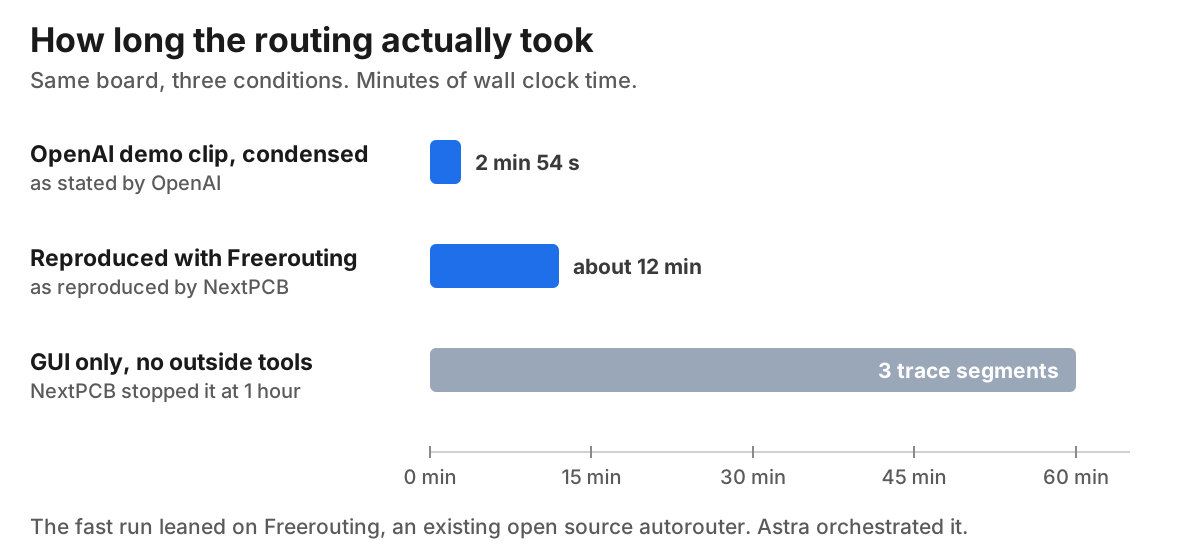
- When an independent tester reproduced it, the fast run came from Astra orchestrating Freerouting, an existing open source autorouter, not from Astra solving the routing itself.
- Restricted to the KiCad interface with no outside tools, it managed three short trace segments in an hour.
- Routing is real work, but it is not the step that decides whether your product works.
What the GPT-6 Astra PCB demo actually showed
OpenAI describes the demo as the model turning an electronic schematic into a manufacturable board by placing components and routing copper. The framing is reasonable: PCB layout is manual, it is slow, and it is a common source of delay. If you have ever spent a weekend nudging traces around, the clip lands.
Two things to hold onto. The run started from a finished schematic, which means somebody had already decided what the circuit was. And 2 minutes 54 seconds is the routing, not the project.
What independent testers found
NextPCB ran the test twice on the same board, with component placement fixed and the copper unrouted.
In the first run, Astra was free to use whatever it wanted. It exported a DSN file out of KiCad, handed it to Freerouting, and imported the SES file back in. Roughly 12 minutes, routed board at the end. That is a genuinely useful piece of automation, and it is also, in their words, orchestration rather than solving. Freerouting did the routing computation.
In the second run they blocked outside tools and made it work through the KiCad interface. After an hour they stopped it. Three short trace segments.
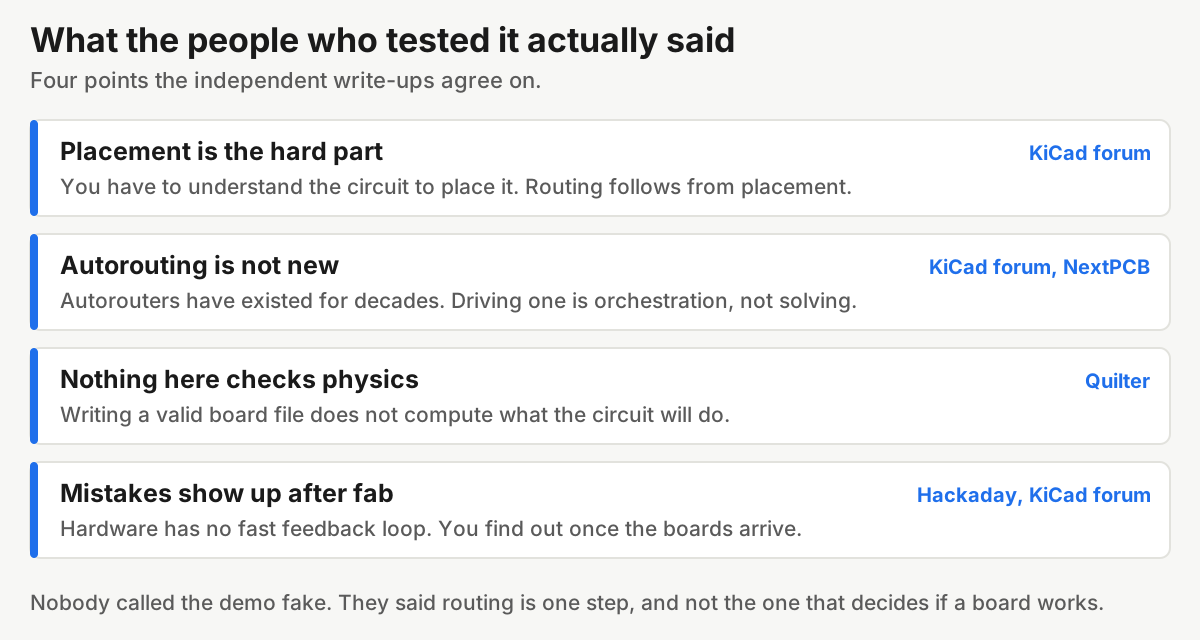
Hackaday was more or less positive and appropriately hedged, noting Astra scored 69.3 percent, plus or minus 10, on the EEBench benchmark, and that most real boards still need edge case handling, review by more than one engineer, and serious testing before a production run.
The KiCad forum was blunter. The recurring point there is that placement, not routing, is the hard problem, because placement requires understanding the circuit. One member called AI driving decades-old autorouting technology mostly entertainment. Another made a point I think about a lot: the training data problem in hardware is not a shortage of good boards, it is a shortage of bad boards with their fixes attached.
Quilter, who compete in this space, argued that placement and routing are coupled problems that cannot be solved in sequence, and that nothing about generating a valid board file computes what the circuit will actually do. They have an interest in that argument. It still holds up.
The ten steps between an idea and a prototype
If you are a founder rather than an engineer, this is the part that matters. Routing is step six.
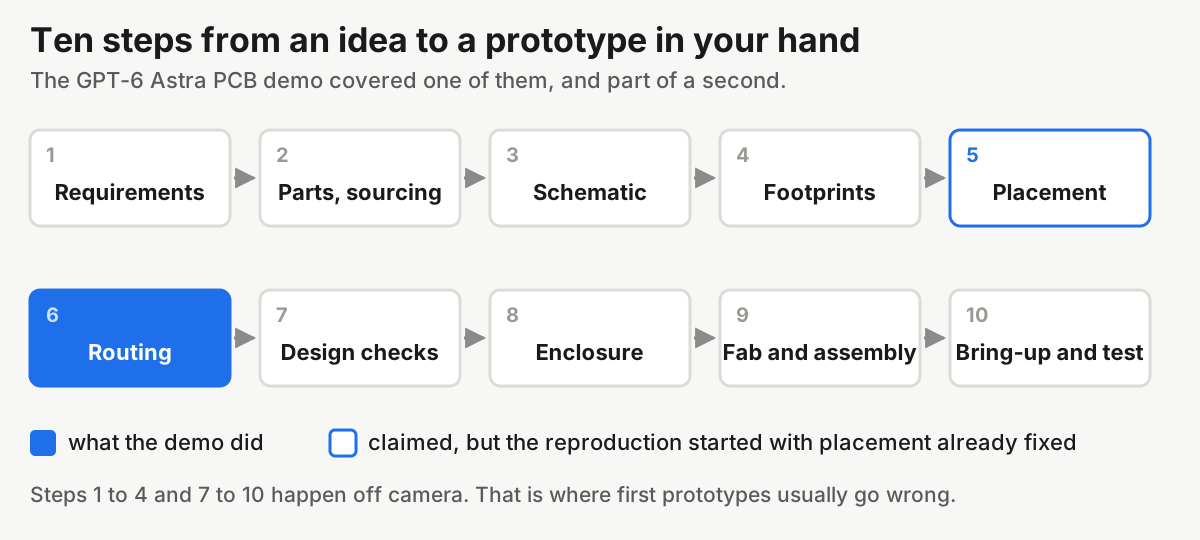
Before you route anything, someone has to decide what the product needs to do, choose parts that are in stock at a price you can live with, draw the schematic, and get the right footprints attached to every part. After routing, someone has to run the design checks, decide on an enclosure, generate fab and assembly files and place the order, then bring the hardware up when it arrives and figure out why it is not doing what it should.
Every one of those is a place a first prototype dies. I have watched more projects fail on a part with a 30 week lead time or a footprint that was one pad off than on bad routing. Routing is visible, so it feels like the work. It usually is not.
What actually decides whether your prototype works
Three things, in my experience.
Parts you can actually buy. A design that specifies a part nobody has in stock is a drawing, not a product. This is unglamorous and it kills schedules.
Placement that reflects the circuit. The forum critics are right about this. Where you put the regulator relative to its input capacitor is a decision about physics, and a router downstream of a bad placement will cheerfully give you a board that routes cleanly and behaves badly. I wrote more about this in why your autorouter keeps failing.
Catching mistakes before you pay for them. Software has a fast feedback loop. Hardware does not. You find out three weeks and a few hundred dollars later. If you want the real numbers on that, I broke them down in how much a hardware prototype costs.
Where Tovan fits, and where it does not
This is my product, so weigh it accordingly. Tovan is built around the whole chain rather than one step: you describe the device in plain English, it picks and sources real in-stock parts, draws the schematic, lays out and routes the board, runs design checks, generates a custom-fit 3D printable enclosure, shows you the prototype in 3D before you commit, and lets you order it. When the hardware arrives it writes you a bring-up guide. It can also simulate the circuit before you order, which is the cheapest place to find a wrong resistor value.
The limits are real and I would rather you hear them from me. Tovan does not write firmware. It stops at 4 layers. It is the wrong tool for high-speed digital, RF-heavy designs, or anything going straight into a certification lab. If that is your product, hire an EE. The end-to-end claim only means something within those bounds.
So which one should you use
If you are an engineer who already has a schematic and a placement you believe in, a routing assistant is a real time saver, and Astra driving Freerouting is a preview of how that will feel. Use it.
If you are a founder with an idea and no ECAD skills, a router does nothing for you, because you are stuck at step three, not step six. You need the whole path, whether that is a tool like mine, a contract engineer, or a design firm. Judge any of them on what shows up in the mail, not on how fast the copper gets drawn.
FAQ
Can GPT-6 Astra design a PCB?
It can produce a routed board from a schematic, which is real. In the independent reproduction, the fast result came from Astra driving Freerouting rather than routing on its own, and restricted to the KiCad interface it made very little progress in an hour.
Did Astra do the placement too?
OpenAI's description mentions placing components and routing copper. The reproduction that people could check started from a board with placement already fixed, so the placement claim is the part I would want to see tested more before leaning on it.
What is EEBench and is 69.3 percent good?
It is a benchmark for electrical engineering tasks. Hackaday reported Astra at 69.3 percent, plus or minus 10, in the same range as other frontier models. Treat it as a signal about one slice of the work, not a readiness score for your product.
Does this mean I do not need an electrical engineer?
For a simple prototype, increasingly no. For anything high-speed, RF-heavy, safety-relevant or headed for certification, yes, you still do, and you will save money hiring one early rather than after two failed runs.
Is AI PCB design in 2026 good enough to order boards from?
For low-speed, low-layer-count designs with parts that are in stock and checks that actually run, yes, people are ordering and getting working hardware. The risk is not that the copper is ugly. The risk is a part choice or a footprint nobody verified.
Can any of these tools write my firmware?
No. Not Astra in this demo, not Tovan, not the layout tools. Plan for firmware separately, and ideally before you order hardware.
What should I actually do with this news?
Take it as evidence that the boring parts of hardware design are getting automated fast, and that the judgment parts are not. Then go work on the step you are actually stuck on.
The demo deserved the attention. It just answered a different question than the one most people were asking.
0 comments